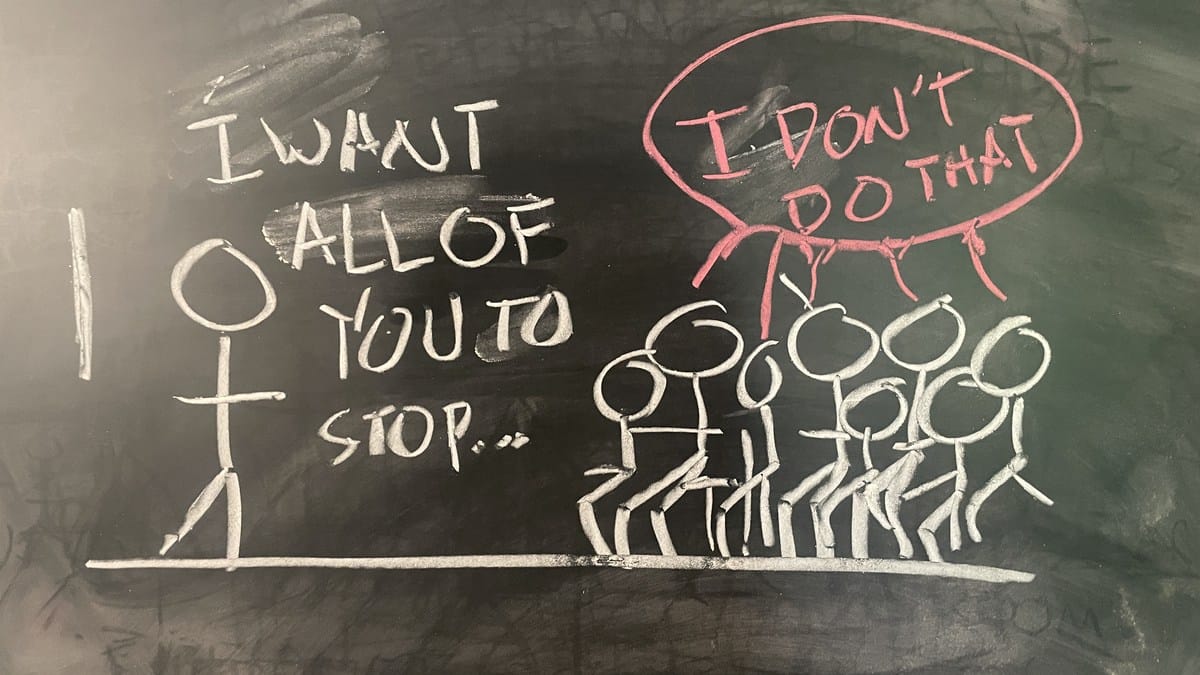
A CEO stands up in front of the whole company and says people are not following the systems. Everyone in the room knows exactly who that is about. Everyone except the one person it is about.
That is the moment the blame culture gets built. Not in a values document. Not in a performance review system. Right there, in one meeting, because a leader could not have a conversation with one human being and used twenty of them as a delivery mechanism instead.
Blame cultures are not a failure of values. They are one avoided conversation, broadcast.
Why leaders address the room instead of the person
Twenty years of doing this and the pattern has not changed. People fear confrontation. Not universally. With specific people.
It is almost never about the org chart. There is one person who lands somewhere in an old part of the nervous system, and the leader will do almost anything rather than sit across from them and say the direct thing. And that person, somehow, is always on the leadership team. I have my own read on why that happens and it belongs in a different conversation.
So the leader takes the only route that does not require the conversation. They address the room. The systems talk. The expectations talk. The tone-setting talk that is really just one message wrapped in twenty envelopes so it does not have to be handed to anyone directly.
The math on that is terrible and it is worth being precise about it.
What blaming the whole team actually costs you
When a leader dumps a shame bucket on the company because a few people are not following systems, watch the room. It splits.
Everyone who is already doing the work absorbs a message that was not for them. They came in on time, they followed the process, they did the thing, and they just got told the company has a problem with people like them. That is a tax on the exact people you least want to tax.
The A players read it accurately. They are not confused about who the message was for. They watch a leader who cannot say a hard thing to one person choose to say it to everyone instead, and something in their assessment of that leader permanently adjusts. A players do not respect a CEO who cannot confront a C player. That is not an opinion, it is a fact I have watched play out for two decades.
And here is what makes it almost funny. The person it was aimed at is not sitting there thinking they mean me, I should change. That guy is the single most oblivious person in the room. He walks out unchanged and keeps doing exactly what he has been doing, because nobody has ever told him not to.
So the leader has taxed the best people in the building, lost standing with the ones who have options, and left the actual problem sitting exactly where it was. All to avoid one conversation.
Praise publicly, rebuke privately. That framework exists for a reason, and the reason is arithmetic.
The difference between accountability and blame in a company
Accountability is prospective and operational. Who owns this. What does owning it require. What happens when the outcome misses.
Blame is retrospective and relational. Who caused this, and what does it say about them as a person.
Companies that run on blame fill up with people managing their exposure instead of their contribution. They make conservative calls. They over-document. They build strong cases for why what they did was reasonable. Nobody takes a risk, because risk creates the possibility of a bad outcome and a bad outcome feeds the machine.
The blame version is also where my own line does its work. If it is my fault, it is my circumstance. If it is your fault, it is your character. The leader who missed the number had conditions. The employee who missed the number is careless. Same miss, two different explanations, and the difference is only who is standing there.
There is a version of this outside of work that makes it obvious. A parent complaining that they have to pay for their kid's college. No you do not. You are choosing to. You made a decision and you are describing it as a burden that happened to you, which is a very comfortable place to stand and does nothing for anybody.
The professional version is the delegation trap. A leader hands off the work, then micromanages the work, then blames the person for not owning the work. The person never had it. They were holding it while someone else drove. That is a leader complaining about a circumstance he authored.
Why the first accountability conversation goes badly
Now the part almost nobody warns leaders about.
A leader who has avoided confrontation has not just avoided some conversations. He has built a system. Every person in that company has learned, through repetition, that nothing happens. That is not neglect, that is training. They learned it from him.
So when accountability arrives, the first conversation is not the beginning of accountability. It is the bill for its absence.
It goes in stages, and they are predictable. First, disbelief. Yeah, yeah, okay. They do not believe you mean it, because for years you have not. Then, the moment they realize you might actually mean it, they challenge it. Hard. That is not insubordination. That is what any human does when the rules change without warning. If mom and dad never punished me and suddenly they do, my first move is not compliance. It is what the hell is this.
Two weeks into a job, a manager sits me down for a healthy one on one about accountability and that conversation sets the tone of the entire culture for me. Same words, seven years in, after seven years of nobody saying anything about a thing I have been doing the whole time? I am going to challenge the hell out of that. I am going to put that CEO in their place. I will wreck their day.
Same conversation. Opposite outcome. The only variable is when.
That challenge rattles leaders, and it should not. It is not evidence the person is toxic. It is evidence of what they were taught, and of who taught them.
How to build accountability into a company that never had it
Push through. That is most of it, and it is not satisfying.
Building a culture of accountability where none existed takes time and patience, and the leader has to eat the first several rounds without flinching and without taking it personally. The pushback is the system unwinding. It gets easier around the third or fourth conversation, when people start to understand the rules changed for real.
And the discipline that holds it together is this. Do not get mad at the team. It originated as a leadership problem. The person pushing back is running the exact playbook the culture rewarded, and the culture was built at the top. The temptation is to look at the guy who wrecked your day and assign him character. His behavior has a circumstance, and the circumstance is you.
That is the whole trade. You take character for your part, you let their part stay theirs, and you keep having the conversation directly with the person it belongs to. That is what accountability without blame actually looks like. It is not a framework. It is a leader who is willing to sit across from one specific human and say the true thing, over and over, until the company learns that words mean something here.
If you're a CEO who keeps addressing the room
Name the person. In your own head, right now. There is one, and you know who it is, and you have known for a while.
Then look at your last few all-hands or leadership meetings and count how many messages you delivered to twenty people that were meant for that one. Every one of those cost you A-player standing and produced no change in the person you were aiming at.
Have the conversation. It will go badly the first time. That is not a sign you were wrong to have it. It is the bill for the years you did not.
If you're an ED running a nonprofit at five to fifty million in giving
Mission gives avoidance better cover than anything in the for-profit world. The direct conversation feels unkind, and unkind feels incompatible with the work. So the ED addresses the room, gently, in mission language, about how we all need to be pulling together right now.
Every person carrying the load hears that they are not doing enough. The person who is not carrying it hears nothing at all, because they never do.
The staff who could go work anywhere are the ones who leave. Not because the work got hard. Because they watched a leader who could not say a hard thing to one person say it to all of them instead, and they decided that was not a place where they could do their best work.
Frequently asked questions
What is the difference between accountability and blame in a company? Accountability is prospective and operational: who owns this, what does ownership require, what happens when the outcome misses. Blame is retrospective and relational: who caused this and what does it say about them. Companies running on blame fill with people managing their exposure rather than their contribution, which produces conservative decisions, over-documentation, and defensive case-building instead of risk.
Why do leaders address the whole team instead of the person who has the problem? Because they are avoiding a specific confrontation, usually with one specific person, and the group setting lets them deliver the message without handing it to anyone. It never works. The people already doing the work absorb a message meant for someone else, the strongest performers lose respect for a leader who cannot confront directly, and the person it was aimed at is almost always oblivious and walks out unchanged.
Why don't A players respect a leader who avoids confrontation? Because they can see exactly what is happening. When a CEO cannot address a C player directly and blasts the room instead, the high performers understand they are being taxed for someone else's behavior while the actual problem goes unaddressed. They rarely leave over the C player. They leave over the leader who cannot handle the C player.
Why does the first accountability conversation go so badly? Because it is not the beginning of accountability, it is the bill for its absence. Years of nothing happening trained everyone that nothing happens. When the rule changes, people first disbelieve it and then challenge it hard, which is a normal human response to rules changing without warning. Two weeks into a job that conversation sets culture. Seven years in, it starts a fight. Same conversation, different timing.
How do you build accountability without creating a blame culture? Have the conversation with the specific person it belongs to, privately, and keep having it. Praise publicly, rebuke privately. Expect the first few rounds to go badly and do not take the pushback personally, because the pushback is the old system unwinding. And do not get angry at the team when it happens, because the culture that taught them nothing would happen was built at the top. Own your part fully, let theirs stay theirs, and stay direct.
Your company is not full of people who will not be held accountable. It is full of people who learned, accurately, from watching you, that accountability does not happen here. That is fixable. It starts the day you stop talking to the room about one person and start talking to the person, and it takes longer than you want, and it is worth every uncomfortable conversation it costs you.
Take this if it serves you.
Much Respect,
-bryan