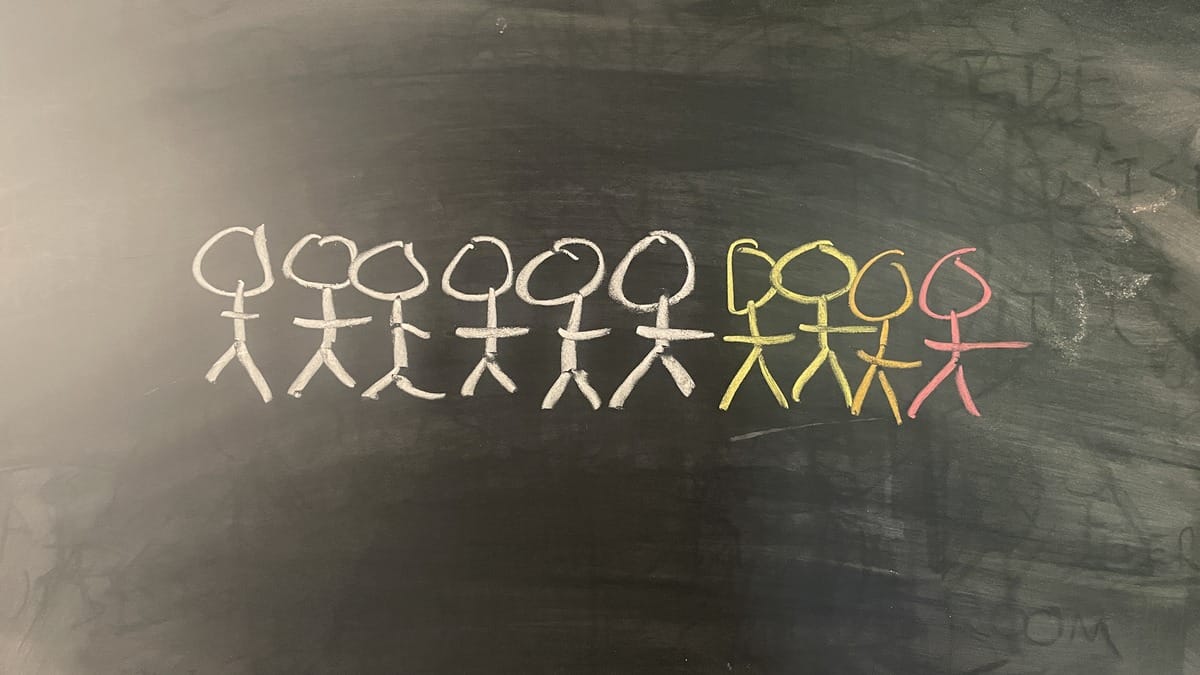
Your org chart says you manage seven people. You have a leadership team, they have their teams, the boxes are clean, the spans look healthy. On paper, you are running a well-structured company.
Then why does it feel like you are holding all of it in your hands.
The org chart does not show what you are actually carrying. You are not managing seven people. You are managing seven, plus the three accounts you never actually handed off, plus the design reviews you still sit in because you came up in design, plus the two directors whose work you quietly redo, plus their teams, because the moment you started managing a director at the task level you took on everyone that director manages. Count that way and the real number is not seven. It is closer to forty. And forty is well past the number where a human being can coordinate by relationship instead of by structure.
The gap between the org chart and what you are actually carrying is your shadow org. It is where culture quietly breaks. Not because anyone is doing anything wrong. Because you crossed a threshold you cannot see, and the whole company is now paying for it in symptoms nobody has traced back to the source.
Why the 10-person threshold is about management load, not headcount
There is a real threshold, somewhere around ten, where coordinating a group by relationship stops working and you have to coordinate by structure instead. Most people apply that number to headcount. Company hits ten employees, install some systems. That version is true and it is also too small.
The threshold is not about how many people the company has. It is about how many people any one person is actually managing. And the person who blows past it first, almost always, is the one at the top.
The math is not opinion. J. Richard Hackman, the Harvard psychologist who spent his career studying why teams succeed and fail, described it with one formula. The number of communication links in a group is n times n minus one, divided by two. Five people is ten links. Ten people is forty-five links. Fifteen people is one hundred and five. The work of managing a group does not grow with the number of people. It grows with the number of connections between them, and that number climbs almost exponentially. Hackman's own rule was blunt. No team in the double digits. His preferred size was six.
So when you extend yourself past your leadership team, down into the domains you are comfortable in, you are not adding a few tasks to your plate. You are adding links. Every account you keep, every review you sit in, every director you manage at the detail level, drags in all the connections attached to it. The plate does not get heavier by addition. It gets heavier by multiplication. This is why you can have a leadership team of seven and a shadow org that runs to forty. It is forty. The org chart just cannot show it to you.
The culture symptoms of an overloaded CEO
The bill does not arrive labeled "the CEO has a shadow org." It arrives as culture.
Decisions get relitigated, because the team knows you might reopen anything you care about, so nothing feels truly decided until you have blessed it. Your leadership team stops fully owning outcomes, because they have learned that ownership is conditional, that you will reach in when it matters to you, so why carry the full weight. Things slip in the gaps, because the coordination that used to run through your attention now exceeds your attention, and the parts you are not touching this week go quiet. Good people get tired in a way they cannot explain, because they are working inside a system where the real authority keeps moving depending on where you happen to be looking. And the whole thing starts to feel off, culturally, in a way that a values exercise and an offsite will not fix.
Leadership looks at these symptoms and reads them as a people problem. The team is not aligned. We need better accountability. Maybe it is a culture issue. So the response is to manage the people harder, which means reaching in more, which grows the shadow org further, which produces more of the exact symptoms it was meant to solve.
The symptoms are real. The reading is wrong. This is not a culture problem. It is a shadow org problem wearing a culture problem's clothes.
Why talking too much in meetings signals an overextended leader
You do not need an audit to find out if this is you. Sit in your next leadership meeting and notice how much of it is you talking.
The single clearest signal of a shadow org is the CEO who carries the room. Every topic routes through you. Every decision waits for your read. You fill the silences, you supply the answer, you move the meeting along by contributing to all of it. It feels like leadership. It feels like adding value. It is the opposite.
Every point you make in that room is a decision you just pulled back onto yourself. Every time you resolve the thing instead of letting the person whose job it is resolve it, you take the monkey off their back and put it on yours. A meeting where the leader talks the most is not a meeting where the leader is leading. It is a meeting where the leader is re-absorbing everything the structure was supposed to hold.
I have a line I come back to on this. The more I talk, the less I say. The leaders who have actually let go of the shadow org are usually the quietest people in their own meetings. They watch. They listen. They let the team run the decision, and they find out, in real time, whether the team can run without them. The talking is not the leadership. The restraint is.
How CEOs reduce their management span without losing control
The fix is not motivation and it is not another culture initiative. It is getting honest about your shadow org and moving the coordination you are hoarding out of your head and into structure.
Name your actual shadow org. Not the org chart. The real one. Write down every person, account, decision, and review you are personally coordinating right now, including the ones that are not supposed to be yours anymore. Most leaders who do this find a number two to five times larger than their direct reports. That number is your real constraint.
Move the coordination into structure instead of attention. The two that matter most here are a function map and a decision log. The function map names who owns what, for real, so decisions route to the owner instead of to you. The decision log records what was decided, by whom, and as of when, so decisions stop reopening every time you glance at them. Between them, they take the coordination that currently lives in your presence and put it somewhere the company can reach without going through you.
Then leave the domain you are comfortable in. This is the hard one, because the domain you keep reaching into is almost always the one you are best at and enjoy most. The design reviews, the big accounts, the product calls. That comfort is exactly what grows your shadow org past what a person can hold. Handing it off feels like loss before it feels like leverage. It is leverage.
And in the room, talk less. Let the silence sit until the person whose decision it is fills it. You will learn more about whether your team actually works in one quiet meeting than in a year of meetings you carried.
If you're a CEO of a company past 30 or 40 people
Your leadership team being under ten does not mean you are safe. It usually means the opposite. The smaller and more capable your leadership team, the more room you have to reach past it into the domains you love, and the bigger your shadow org gets while the org chart stays clean. Do the inventory first. If the number you write down is well past your direct reports, that gap is your ceiling, and no amount of hiring below it will help until you stop coordinating the shadow org by hand.
If you're leading a leadership team that isn't clicking
Sometimes the most useful move is to take yourself out of the driver's seat in your own room. When the CEO runs the meeting, the CEO's shadow org stays intact by default, because the structure of the conversation routes everything back through them. I have watched leadership teams change character the moment the CEO stops driving and gets to just watch and listen instead. It is part of why an outside facilitator can be worth so much at this stage. Not because the team needs managing, but because it frees the one person who can never usually sit back to actually see their team work without them. If your meetings only function when you carry them, that is not a sign the team is weak. It is a sign the room has been built around your shadow org, and the room can be rebuilt.
Frequently asked questions
Why does my company culture feel broken even though my org chart looks healthy? Because culture symptoms are often shadow org symptoms in disguise. If a leader is personally coordinating far more people and decisions than their direct reports, the overload shows up downstream as relitigated decisions, weak ownership, work slipping through gaps, and a team that feels off. Those look like culture or accountability problems, so leaders manage the people harder, which grows the shadow org and deepens the symptoms. The fix is structural, not cultural.
How many people can one leader actually manage? Fewer than most org charts assume, because the load is not the number of people, it is the number of connections between them. Hackman's formula, n times n minus one over two, means five people generate ten links and ten people generate forty-five. The links grow almost exponentially, which is why coordination by relationship breaks somewhere around ten and has to be replaced by coordination through structure.
What is a shadow org and why does it matter? A shadow org is the gap between the people a leader manages on paper and the people and decisions they are actually coordinating in practice. A CEO with seven direct reports who still runs key accounts, sits in reviews, and manages two directors at the task level is really coordinating those directors' whole teams too. The real span can be several times the org-chart number, and it is the true ceiling on how big the company can get.
Why is talking a lot in meetings a bad sign for a leader? Because every contribution a leader makes in a meeting is usually a decision they just pulled back onto themselves. When the leader carries the room, they re-absorb the work the structure was supposed to hold, and the team learns to wait rather than own. Leaders without a shadow org tend to be quiet in their own meetings. They watch, they listen, and they let the team run the decision.
How do I reduce my management span without losing control of the business? Start by writing down your real shadow org, every person, account, and decision you are personally coordinating, including the ones that are no longer supposed to be yours. Then move that coordination into structure, primarily a function map that names true owners and a decision log that keeps decisions from reopening. Then hand off the comfortable domain you keep reaching into, because that is usually what grows the shadow org the most. Control does not come from touching everything. It comes from building a structure that holds the things you let go of.
You cannot grow past your capacity to micromanage it. The company can only ever be as large as the coordination one person can personally carry, and the moment you try to carry more than a person can hold, the excess does not disappear. It leaks out as culture symptoms, tired people, and decisions that will not stay made. The org chart is not the constraint. Your shadow org is. And the quiet, structural work of pulling that back to something a human can actually hold is the difference between a company that grows past you and a company that stays exactly the size of what you can micromanage.
Take this if it serves you.
Much Respect,
-bryan