The CEO is the only person in the building who cannot talk to anybody in the building about the hardest things.
Read that twice.
The team cannot be told about the cash situation in detail because it would create panic. The board cannot be told about your doubt because it would create panic. Your spouse cannot be told about the operational complexity because they do not have the context to help. Your friends cannot be told about the strategic decisions because they are not bound by the same confidentiality. Your kids cannot be told about any of it. Your therapist can hold some of it but does not know your business. Your competitors are the only people who would actually understand the situation, and they are exactly the people you cannot talk to.
So the founder sits at the top of the org chart, doing the hardest job in the company, and runs out of people they can be honest with about what is actually happening.
Most founders solve this problem by not solving it. They get used to the isolation. They tell themselves it is the cost of leadership. They develop a public persona that can absorb the question "how's the business" with a smooth answer that does not require them to actually say anything.
This is not leadership. This is a coping mechanism that is going to cost you somewhere expensive eventually. The cost shows up as bad decisions made in isolation, mental health spirals nobody saw coming, marriages that strain because the founder has no other outlet for the weight, or a founder transition that goes badly because nobody saw the founder's head clearly enough to predict it.
The fix is not a formal advisory board. The fix is a coaching stack. And almost nobody talks about how to build one.
THE FORMAL ADVISORY BOARD IS NOT THE ONE THAT MATTERS
The corporate advisory board is usually performative. Three to five people listed on your website. Quarterly meetings with slide decks. Industry credibility. Maybe some warm intros. The members are useful in their domains and the meetings are fine. The advisory board does not, however, hold you. That is not what it is for. That is not what those meetings are structured to do.
What you need, separately and additionally, is a personal coaching stack. A set of individual relationships, each serving a different function, that you can be fully honest with about what is actually happening in your life and in the business. Not at quarterly meetings. In the moments you actually need them. When something is happening and you cannot think alone.
Most founders do not have this. They have an accidental version of it that is whoever happens to be available when they need to vent. That is not a coaching stack. That is acquaintance hour. The signal that distinguishes the two is whether the conversation produces a clearer head and a better next decision, or whether it produces sympathy and inertia.
HOW I THINK ABOUT THIS
I never trust a therapist who does not go to therapy.
That is not a throwaway line. It is the operating principle behind everything I am about to say. The leaders I trust most are the ones who have submitted themselves to the same process they are asking their people to go through. The coach who has never been coached. The therapist who has never done the work. The founder who preaches vulnerability and has not been honest with anyone in three years. I can spot the gap immediately and so can everyone else in the room.
I have a spiritual coach, a physical coach, a financial coach. I bring in other coaches and mentors as I am working on something specific. They rotate in and out of my life based on what I am trying to sharpen. That is not a luxury. That is the operating system.
When I am facilitating a room of leaders and we run the GRID, which maps what each person is good at and loves, good at and hates, bad at and loves, bad at and hates, the people who land in "bad at it, love it" get a specific prescription from me. Get a coach. If it gives you energy, lean into it and build the skill. But do not lean into it alone. Find someone who has already built that skill and let them shorten your learning curve.
That is the principle. It applies to the GRID. It applies to every founder sitting at the top of an org chart wondering why they feel so alone.
WHAT THE STACK LOOKS LIKE
The coaching stack is not a fixed structure. It is a set of functions that need to be filled, and the specific people filling them change as the company and the founder evolve.
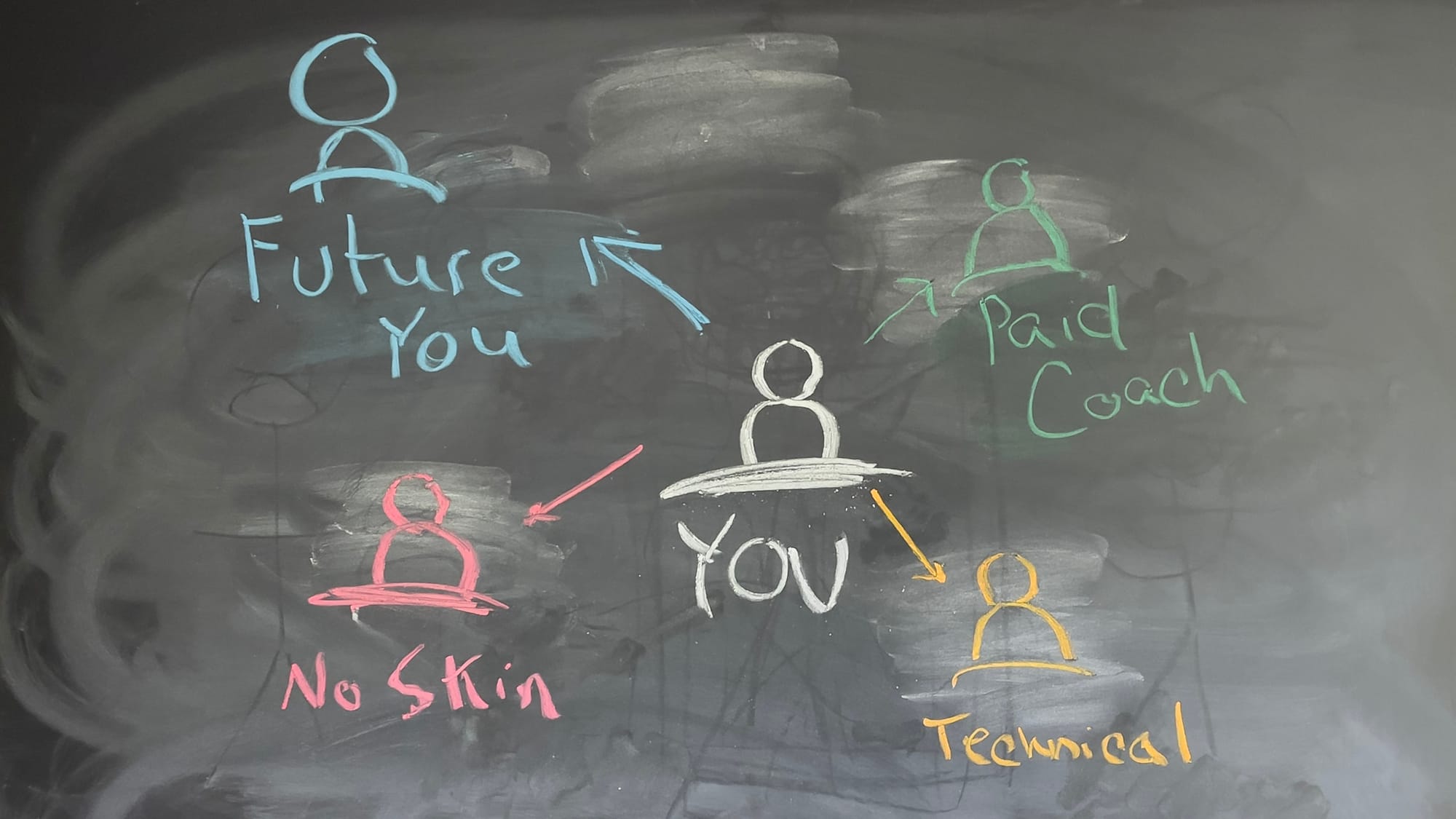
Paid Coach. You need someone who is paid to tell you the truth. A coach, a therapist, a specific kind of advisor. The paid relationship matters because it removes the social friction from honesty. They are not worried about your feelings because they are not your friend. They are worried about your growth because that is what you hired them for. I work with two to three founders at any given time in this capacity. I am not the only coach in their stack, and I should not be.
Future You. You need a peer who is five to ten years ahead of you. Not in your industry necessarily. In the founder experience. Someone who has already navigated what you are about to navigate. Their value is not advice. Their value is pattern recognition. "I went through this exact thing two years ago and here is what I wish I had known." Nobody else has that vantage.
Technical. You need technical coaches for the domains where the company is heading. This is different from hiring the expertise. This is building a relationship with someone who thinks in that mode so they can ask you the question you would not ask yourself.
No Skin. You need at least one person with no skin in your game. No equity, no fee, no professional dependency on you. Someone who can tell you the thing nobody else will because nobody else can afford to. If everyone in your professional orbit has a financial relationship with you, your information environment is compromised in ways you cannot see.
The stack evolves. The specific people rotate based on what the company needs and what the founder needs. What does not rotate is the commitment to having the stack in the first place.
WHAT THIS LOOKS LIKE IN PRACTICE
A founder I work with brought up M&A last year. Not as an immediate plan. As a direction he was starting to think about.
The first thing I did was hand him a book. The Outsiders by William Thorndike. Eight CEOs who made capital allocation decisions that outperformed the market by extraordinary margins. I told him to read it before we talked about M&A again. He needed the conceptual frame before he could ask the right questions.
Then we built the stack around the strategic question.
Find an M&A firm, not to hire yet, but to start the relationship. Understand how they think. Start reading and listening in that space. Podcasts, books, case studies. Get fluent in the language before you need to speak it under pressure.
Find an attorney who has lived in M&A for their career. Not as a service relationship on this side of a deal. As a thinking partner. Someone who has seen the inside of enough transactions to tell you what the books do not.
Find someone who has been through it personally. Not a professional. Not someone you pay. Someone you can play golf with and ask: what was the worst day of the deal? What do you wish you had known? What would you do differently? That conversation over eighteen holes is worth more than most of the formal advisory you will pay for.
That is four different coaches for one strategic question. None of them are me. My job was to help him see that he needed them and point him toward the right ones.
That is what the stack looks like when it is working.
WHY MOST FOUNDERS DON'T BUILD ONE
The reasons are predictable and avoidable.
It feels like asking. Founders who got to where they are by being self-sufficient have an allergic reaction to asking for sustained help. Asking once is fine. Asking on a recurring basis feels like a confession that you cannot do it alone, which the founder identity does not have a comfortable place for.
It feels expensive. A real coaching stack has costs. Coaches and therapists charge real fees. Peers and senior advisors want their time respected, which means showing up prepared and using the relationship well. The cost is real. The cost of not having the stack is much higher and much harder to see in advance.
It feels presumptuous. Founders worry that asking somebody to play an ongoing role in their development is asking too much. Almost every senior person I have ever asked has said yes immediately and felt honored to be asked. The founder's anxiety about asking is not calibrated to how the ask actually lands.
The isolation is uncomfortable but it is also protective.
The deepest reason most founders skip it is the one nobody admits. They are afraid of what honest outside perspective would tell them. The isolation is uncomfortable but it is also protective. A real coaching stack takes that protection away. If you have three or four people who can tell you the truth about what they see, you are going to hear things you did not want to hear. Most founders prefer the comfortable isolation to the productive discomfort.
That is also the core reason it is worth doing. The information you do not want to hear is usually the information that determines your next two years.
WHAT THIS LOOKS LIKE FOR NONPROFITS
If you are an executive director running a nonprofit at five to fifty million in giving, this applies to you with one important shift. Your isolation is structurally worse than the founder's.
You cannot talk to your board because the board is also your fundraisers and you cannot show them weakness. You cannot talk to your major donors because they are watching for signs of organizational stability. You cannot talk to your program directors because they look to you for stability. You cannot talk to your peer EDs in the same cause space because you are competing with them for the same funding pool.
The need for a coaching stack for an ED is at least as high as it is for a founder. The composition is similar with different specifics. The peer ahead of you is another ED who has already navigated a major capital campaign, an ED transition, a board crisis. The technical coach might be a fundraising consultant, a finance person, a board governance expert, depending on what the company needs and what you need. The no-skin-in-the-game relationship is even more critical because every professional relationship in your world is potentially funder-adjacent and therefore compromised.
If you are an ED reading this, the advisory work for your role is not optional. The structural isolation is too high. Build the stack.
WHAT TO DO WITH THIS
This week, write down the names of the people you would actually call if something significant happened in the next thirty days. Cash crunch. Major customer loss. Senior executive resigning. Family crisis affecting your work. An offer to be acquired. A diagnosis.
Write the names. Not the roles. The names.
If you have five names that cover different functions and at least one of them has no skin in your game, you have a coaching stack. Make sure each of those people knows they are in that role and make sure you are using them on a recurring cadence rather than only in crisis.
If you have fewer than five names, or the names you have all come from the same category, you have a gap. Identify which function is missing and start the search to fill it. The search takes months. The stack is worth it.
If you cannot fill a name in any of the seats, your isolation is acute and you should treat it as a top operational priority for the next ninety days. There is no founder community, no podcast, no retreat that substitutes for individual relationships. Build the relationships.
The advisory board nobody talks about is the one that determines whether you can do this job for ten years instead of three.
So much respect.
FREQUENTLY ASKED QUESTIONS
Why do founders feel isolated even when they have a full team around them?
Because the team cannot be told everything. The cash situation. The doubt. The strategic options being weighed. The founder carries information that would create panic if it moved down the org chart, and that information has nowhere to go. The isolation is structural, not personal. The fix is building relationships outside the org that can hold what the org cannot.
What is a personal coaching stack for a founder or CEO?
It is a set of individual relationships, each serving a different function, that a founder can be fully honest with about what is happening in the business and in their life. A paid truth-teller. A peer who is ahead of them. Technical coaches for the domains where the company is heading. At least one person with no skin in the game. The specific people rotate as the company and the founder evolve. The commitment to having the stack does not.
How many coaches does a CEO actually need?
More than one and fewer than you think. The number is less important than the coverage. You need someone who will tell you the truth, someone who has been where you are going, someone who thinks in the mode you are weakest in, and someone who has nothing to lose by being honest with you. If those four functions are covered by three people, fine. If they require six, fine. Cover the functions.
What is the difference between a formal advisory board and a personal coaching stack?
A formal advisory board is a corporate structure. It meets quarterly, it has slide decks, it provides domain credibility and warm intros. It does not hold you. A personal coaching stack is a set of individual relationships built for honesty, pattern recognition, and real-time thinking partnership. The two are not the same and one does not substitute for the other.
How do you ask someone to be part of your personal coaching stack without it being awkward?
Be direct and specific. Tell them what you are working on, why you value their perspective, and what kind of engagement you are looking for. Most senior people say yes immediately and feel honored to be asked. The founder's anxiety about asking is almost never calibrated to how the ask actually lands. The awkwardness is in your head more than in the room.
Does this apply to nonprofit executive directors?
More than it applies to founders. The structural isolation for an ED is worse because every professional relationship is potentially funder-adjacent. You cannot show weakness to your board because they are also your fundraisers. You cannot show weakness to your major donors because they are watching for stability signals. The coaching stack for an ED is not optional. Build it.