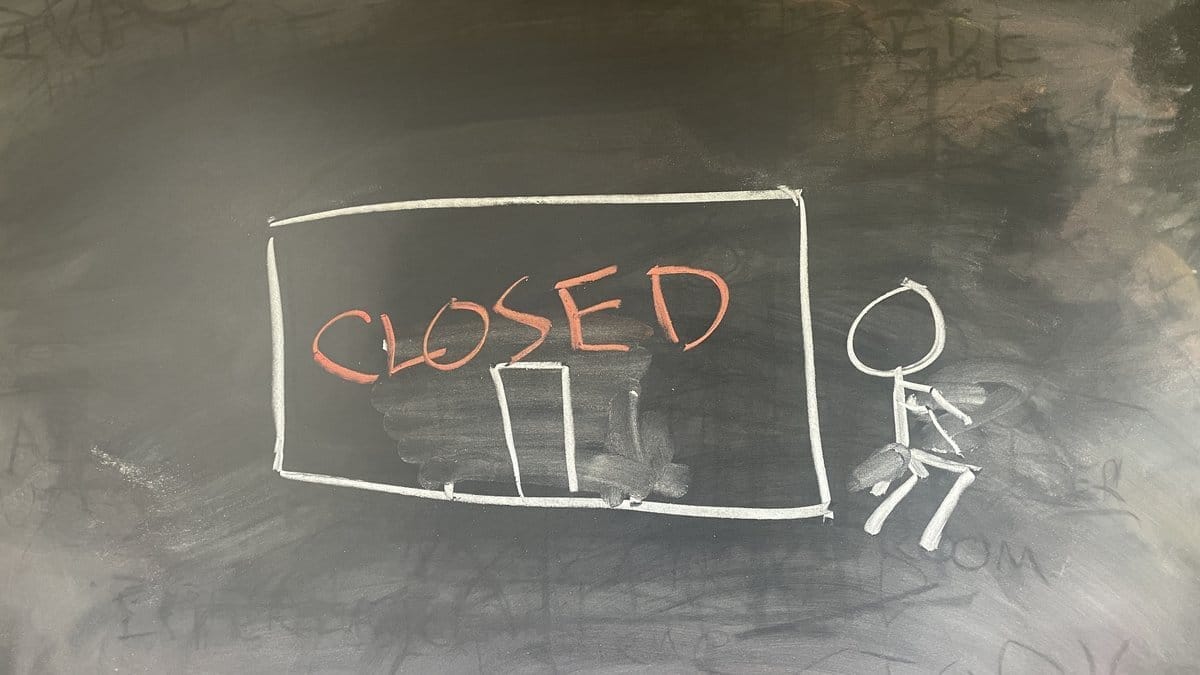
The business we built did not fail all at once. It failed the way most things fail: slowly, then in a rush, then in paperwork.
There is a specific kind of grief that comes with losing a business you built. It is not the grief of losing a job. Losing a job is hard, and this is different. The business was not a job. It was a vehicle for a version of yourself you constructed over years, out of deliberate decisions about what you stood for, what you were building, and who you were becoming while you built it. When the business ends, that vehicle is gone. And the version of you that lived inside it has to find somewhere else to live, or be rebuilt from scratch, or admitted to be someone you no longer are.
None of that is fast. None of it is clean. And almost nobody talks about it honestly in a business context, so the people going through it go through it mostly alone, inside a cultural story that says failure is a learning opportunity, the learning should be extracted quickly, and the next chapter should start now.
The next chapter will come. But the grief has to go somewhere first.
What the grief is actually about
It is not about the money, though the money is part of it. It is not about the embarrassment, though the embarrassment is real. It is not even about the relationships that change, and many of them do when a shared enterprise ends.
The grief is about identity.
Most founders build their company and their sense of self at the same time. The company is not just a business. It is the externalization of a worldview, the evidence that your particular way of seeing the market, the problem, the solution, was right enough to sustain something real. When it ends, the evidence is gone. And you have to live, for a while, with a self-concept that no longer has anything outside of you confirming it.
I can tell you exactly what that felt like, because the first time I lived it I was about twenty-five.
It was the first business I was ever part of that grew the way it did. Early in my life, early in my marriage. We adopted our first child during those years. And the business went from nothing to something I could barely believe. We were doing work all over the country, with major national brands. Blue Cross Blue Shield. Ogilvy. We worked on a campaign with the American Cancer Society to put cancer on the global agenda. We helped almost a hundred nonprofits raise more money and speak with more clarity inside a brand story we helped them find.
I remember a Christmas, about four years in, sitting with my extended family and telling them how far we had come. I was, as far as I knew, the first entrepreneur in the family, the first one building something like this. I remember the pride on their faces while they listened. I felt it in my chest. This was who I was now.
The next year, the business imploded. Same family. Same Christmas. Everyone excited to hear how it was going. And I had to tell them: we closed it. It died.
That was one of the hardest things I have ever had to say out loud. Because my identity, my ego, the part of me that needed the outside world to see me as successful, was wrapped completely around that business. When it died, a version of me died with it, and I had to say so to the people whose pride had meant the most.
What gets skipped
The business culture around failure has gotten better at naming failure as a possibility, even a useful one. The fail-fast language, the embrace of iteration, the normalization of the pivot have all done something good. They made it less shameful to admit a business did not work.
What the culture has not gotten better at is the stretch between the failure and the next chapter. The script skips it. The failure happens, the lesson gets extracted, the founder gets back up, the next venture begins. The timeline is compressed. The grief is minimal. The founder in the script is resilient in a way that looks like they were barely touched by the loss.
The people I know who have been through real business losses are not like that. They were touched deeply. They needed time. They needed to be in a period of not-knowing, where the next chapter was not yet visible and they were not pretending it was.
Skipping that period does not erase it. It defers it. Whoever goes from a failed venture straight into the next one carries the unprocessed grief into the new context. It shows up in decisions made from fear instead of clarity. In the way they relate to risk and commitment. In the patterns they repeat because they never examined what produced them. In their relationship with their own judgment, which tends to carry either too much self-doubt or too little, both of them distortions left behind by a loss that was never worked through.
What working through it actually requires
It requires time. That is the first and most uncomfortable truth. The compressed timeline of the cultural script is not available to the body. The nervus system takes the time it takes. Trying to accelerate it with productivity or busyness or premature optimism produces the deferral, not the processing.
Honesty about what was lost is the second piece. Not just the business. The specific version of yourself the business was building. The relationships inside it. The future you had been imagining inside it. The parts of the work that genuinely mattered to you. Grief has to be specific to be processed. Generalizing it into "the business failed" does not do the work that naming each particular loss does.
You also need someone to be honest with. Not a cheerleader. Not someone who will rush you to the next chapter or remind you how resilient you are. Someone who can sit with you in the not-knowing without trying to resolve it early.
And at some point it takes a serious examination of what was true and what you missed. Not self-flagellation. Not revisionist history that makes the failure someone else's doing. An honest account of where the judgment was sound and where it was not, what you would do differently and why, what the experience changed about how you understand the work of building a business.
What I did instead of skipping it
Here is what I actually did after that business closed, and it is the thing I am most glad I did.
I recorded a series. For six months, maybe longer, I sat down and articulated every mistake I could remember that led to the end of that company. Not a highlight reel. The real list. Brutally honest about everything we did wrong, every place my judgment failed, every decision that looked fine at the time and was quietly killing us.
I never named names. I never went on a public witch hunt or made it anyone else's fault. It was just good old-fashioned business lessons, told plainly. I told the stories out loud, on camera. Doing it that way forced me to articulate them into digestible scripts, structured the way you would teach an episodic course. I published it on Udemy and then, honestly, mostly forgot it existed. Going back to write this, I found it. It is still up, a decade later, every lesson I pulled out of that wreckage sitting right where I left it.
[SCREENSHOT: Udemy course page, "Key principles I learned from owning a Startup That Failed," published 4/2016. Place here.]
But the truth is I did not record it for an audience. I did it so I could turn the failures, the mistakes, the wish-I-had-knowns into lessons clear enough to carry into the next chapter.
That is what processing a loss actually looks like. Not bypassing it. Not blaming. Sitting inside the full weight of what happened, long enough and honestly enough that you come out the other side understanding it. The lessons from those six months are the foundation everything I have built since sits on.
The version of me that came out of that work is the one who now works with founders on the human constraints underneath their operational ones. The fear. The ego. The identity wrapped around the outcome. I can work on those with founders because I have been inside all of them. I know what they feel like. I know how they hide. None of that would have been available to me if I had rushed to the next thing, grabbed a tidy lesson, and left the loss behind.
For the founder in the middle of it
If you are currently inside a business ending, or recently out of one, a few things are worth saying plainly.
The disorientation is real and it is temporary. The version of you that was housed in the business is not the whole of you, even though it feels that way right now. There is more of you than the business got to express, and that more is available on the other side of this. It is often richer for having been through it.
The grief is not a sign of weakness. It is proportional to the significance of what you built. You built something real. It ended. The size of the feeling is appropriate to the size of the investment.
The next chapter will not be better if you skip this one. The clarity you will bring to the next thing, the judgment you will apply, the patterns you will not repeat, all of it lives on the other side of honest engagement with what this one produced. Not bypassed. Through.
And you do not have to do it alone. The cultural script says founders are resilient in private. The ones who come out the other side with the most capacity are the ones who let themselves be supported in the open. Find the real conversations the script around failure tends to prevent. Have them. The next chapter is waiting, and it will be better for having been built on a foundation you actually examined.
If you're a founder or CEO
If you have a business loss in your history that you moved past quickly, it is worth sitting with it now, even years later. The unprocessed version does not stay quietly in the past. It shows up in how you weigh risk, how you hold commitment, and how much you trust your own read of your own business. This is most of what constraint coaching with a founder actually is, not the operational problem on the surface but the human one underneath it, the fear and ego and identity that an unexamined loss leaves running. Working through it is not dwelling. It is clearing the thing that is quietly shaping decisions you think you are making freely.
If you're a nonprofit executive director
Nonprofit leaders navigate a version of this that is structurally different but emotionally similar. The program that was discontinued. The merger that closed but felt like an organizational death. The leadership transition that ended an era. The funding loss that forced a hard reduction in scope. These are not the same as a business failure, but they carry a grief of their own, and most nonprofit cultures are even less equipped than the business world to make space for it. Mission-driven organizations run on commitment, and the norm is to redirect energy fast toward what remains. The grief for what ended gets compressed into a brief acknowledgment and a pivot to resilience. The leaders who navigate organizational loss well are the ones who made space for the grief before the pivot, who named specifically what was being lost, what it had meant, and who was most affected. That acknowledgment does not slow the organization down. It is what lets the people inside it bring themselves fully to what comes next. Surfacing that, out loud and together, is the heart of the leadership facilitation work these moments call for.
What to do with this
If you have a business loss in your history that you moved past quickly, sit with it now.
Write down what you lost specifically. Not just the business. The version of yourself you were building inside it. The relationships. The future you had been imagining. The parts of the work that genuinely mattered to you before it ended.
Then write down what you have never said out loud about it. The part of the story you have not told, not because you are hiding it but because the cultural script did not make room for it.
You do not have to share what you write. The act of writing it is often enough to begin moving something that has been held in place longer than it needed to be.
The next chapter is always better when it is built on a foundation you actually know.
Frequently asked questions
Why do founders grieve a failed business differently than losing a job? A business is not just a job. It is the externalization of a worldview, the evidence that your particular way of seeing the world was correct enough to sustain an enterprise. When the business ends, you lose not just the income and the role but the external confirmation of your self-concept. The grief is about identity, not logistics, which is why it runs deeper and lasts longer than a job loss.
What happens when founders skip the grief after a business failure? Skipping it defers it, it does not erase it. People who move straight to the next venture carry unprocessed loss into the new context, where it shows up in fear-driven decisions, a distorted relationship with risk and commitment, and repeated patterns that were never examined because the loss that produced them was never worked through. The compressed timeline of the cultural script around failure is not available to the nervous system.
What does working through a business failure actually require? Time, which the compressed script does not allow for. Specificity about exactly what was lost, not just the business but the version of self, the relationships, and the imagined future inside it. Someone honest to sit with you in the not-knowing without rushing to resolution. And an honest examination of where your judgment was sound and where it failed, done with enough distance to see clearly. For me that examination took the form of recording every mistake I could name, for six months, until I understood them.
How does business failure make you a better founder or CEO? Not automatically. Only if the loss is worked through rather than bypassed. The founder who stays in it long enough to be honest about what it produced, what patterns were running, where the judgment failed, and what needs to change, comes out with a more grounded capacity than the one who extracted the lesson and moved on. The integration is what makes the learning real.
What should a founder do immediately after a business failure? Resist the pressure to extract the lesson and get back up. Let the grief be specific rather than generalized. Give yourself the time you actually need rather than the time the script allows. Find someone who can hold difficulty without fixing it. And at some point, do the serious examination of what was true and what you missed, not from self-criticism but from genuine inquiry into what the experience can teach that quick extraction never will.
So much respect.