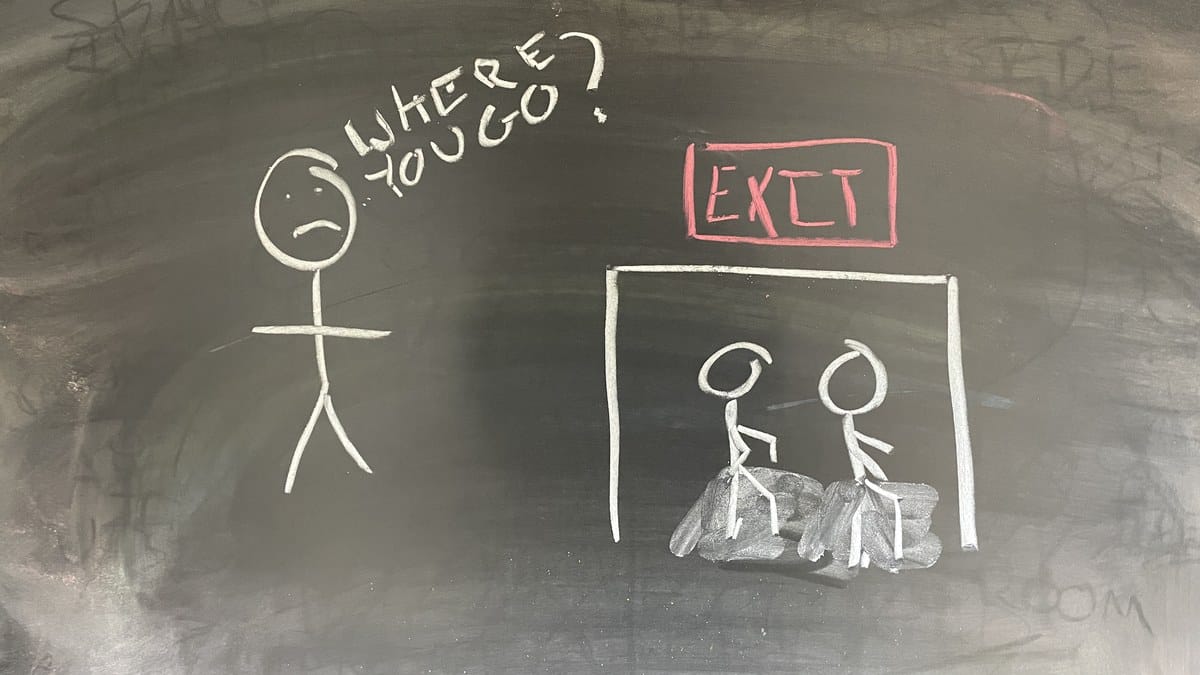
The people most likely to leave your organization are not the ones fighting for it. They are the ones who stopped fighting months ago.
And they are usually your best people. The excellent ones. That lands backwards the first time you hear it. If someone is performing at a high level, the assumption is they are satisfied, valued, getting what they need from the work. So why would they go?
Because the people who are excellent have the most options. They are the most aware of the gap between what they are capable of and what the organization is actually letting them do. They have the highest bar for the environment, the leadership, and the growth they will accept. And when that bar gets crossed, they do not complain about it. They update their LinkedIn and start taking calls.
The leaders about to leave are almost never the ones telling you they are frustrated. They are the ones who stopped telling you. That conversation six months ago, where they raised the thing that was not working and the thing did not change, was not the end of the frustration. It was the beginning of the decision.
Some of them are already gone in every way but the paperwork. The ones still in their seats are deciding right now.
What actually drives a great leader out
This is rarely a compensation problem. Comp can be the thing that tips a decision once an outside offer is on the table, but it is almost never the root. The root is usually one of three things. The work stopped being generative, the leadership stopped being worth following, or the environment got too expensive to stay in.
The work stops being generative when the person has outgrown the role and the organization either does not see it or does not have the next thing to give them. High performers are always moving toward more challenge, more autonomy, more impact. An organization that cannot offer any of the three is one they are already in the process of leaving, even if they have not said so, even if they do not fully know it yet.
The leadership stops being worth following when the person above them is not growing, not honest, or not competent enough to earn the trust that real followership takes. High performers have sophisticated leadership detectors. They know within a few weeks whether the person leading them is genuinely good or just performing competence. When it is the second one, they stay as long as the work and the money justify it, and the moment a better option shows up, the math changes.
The environment gets too expensive when the mental and emotional overhead of operating in it costs more than the work gives back. This is self-care reframed as a business problem. An environment where the norms are unclear, conflict never resolves, information does not flow honestly, the interpersonal dynamics take constant managing, and the founder's mood is a weather system everyone navigates around, that environment charges a daily tax to everyone inside it.
High performers feel that tax earlier and more sharply than average performers, because they are more self-aware, hold a higher standard, and have a reference point for the kind of environment they could be in instead. They do not complain about the cost more than anyone else. They just pay it for a shorter stretch before they make a different choice.
The one you are actually causing
There is a principle I found in a book called Topgrading, by Bradford Smart, that I picked up at a Goodwill years ago for a couple of dollars. It has stuck with me more than most things I have paid full price for. The A players leave when the C players are allowed to stay.
That is the version of this I see most in real organizations. Not a comp gap, not a market shift. A founder who will not deal with the people who should be coached up, coached over, or coached out. Because here is the thing your best people are always watching: how you treat your worst ones. The whole company reads it.
When you praise the inefficient ones, your best people see it. When you accommodate a toxic person, or let one skip the accountability to your values that everyone else is held to, your best people see that too. None of it is invisible. The standard you actually hold is not the one written on the wall. It is the one you enforce on the person everyone knows is a problem.
And here is the most common shape it takes. The leadership team sits in meeting after meeting hearing about what is going wrong, when everyone in the room already knows the real issue is one individual, and the CEO will not have the one direct, one-on-one confrontation that would fix it. So out of fear, the founder addresses the many to avoid addressing the one. New policies for everybody. General reminders to the whole team. Group lectures about a problem that has exactly one name on it.
That fear of confrontation plagues the entire company. Your best people, the ones with options and standards, watch you discipline the room to avoid disciplining the person, and they get sick and tired of it. Then they leave. Not because the work got hard. Because they lost respect for what you were willing to tolerate.
The silence before the departure
One of the clearest signals that a high performer is on their way out is a specific kind of withdrawal that does not look like checking out.
They stop bringing problems. Not because the problems stopped. Because the last few times they brought one, nothing changed. The problem went into the system, the system absorbed it, and the next quarter looked exactly like the last. Someone who still cares and still thinks it can change keeps bringing problems. Someone who has decided the system will not change stops spending the energy.
They stop offering opinions in leadership discussions. Not because they do not have any. Because the last few times they said something that cut against the dominant view, it was not worth repeating. The divergence was unwelcome, or the conversation went nowhere, or the decision got made exactly the way it would have without their input. Offering a perspective that never lands is effortful and unrewarding, and high performers stop doing things that are effortful and unrewarding.
They start performing presence instead of being present. The difference is visible once you know to look. They show up. They deliver. They complete the work. But the engagement has shifted. The person who used to be three moves ahead in the strategy conversation is now one move ahead. The creative contribution that used to be reliable is now occasional. They are managing a job instead of building something.
Each of these is a step in the process. By the time you notice the pattern, the person is usually further along than the behavior is letting on.
The investment they can actually feel
High performers stay where the investment in them is real and visible. Not the investment in what they produce. The investment in who they are becoming.
Most organizations invest in their best people the same way they invest in everyone. Performance reviews, the occasional training program, the same comp structure as the rest. The message that sends to someone excellent is, we appreciate your output, and we are not especially invested in your growth.
Excellent people are not primarily driven by appreciation of their output. They are driven by the experience of their own development, the felt sense that they are getting more capable, more effective, more like the person they are trying to become. An organization that does not actively feed that is not a place where a high performer builds a career. It is a place where they do a job.
The investment that keeps them is specific and personal. It means knowing what they are trying to develop, what they find genuinely hard, where their ceiling is and what would lift it. It takes leadership that watches the person, not just the performance, that notices when someone is ready for more instead of waiting for them to ask. That is not a management program. It is the natural output of a leader who actually cares about the people they lead. The compassion and the retention are the same thing.
The environment tax
Most founders have never calculated the environement cost their organization is charging its best people. Not because they do not care. Because the cost is invisible, spread across thousands of small interactions, absorbed one at a time instead of added up.
The meeting that should have been an email. The decision that sat unresolved for six weeks. The tension on the leadership team that everyone has to manage around. The founder's mood on a hard Tuesday that shaped the whole team's afternoon. The performance problem everyone knew about and nobody addressed. All of it is overhead the organization is charging its people, and the high performers pay that overhead while also delivering excellent work. They are running a deficit between what the work takes and what it gives back.
When a competitor or a new opportunity offers an environment with less overhead and comparable or better work, the math moves fast. The high performer is not really leaving for the new opportunity. They are leaving the current cost structure. The new opportunity is just the exit.
Lowering that cost is not about adding perks. It is about removing the friction coming from unresolved conflict, unclear ownership, poor communication, and the slow pileup of things that should have been dealt with and were not. Most of that overhead is not necessary. It is the residue of what the organization chose not to face directly.
What to do with this
Before you lose the next person you cannot afford to lose, have the conversation you have been avoiding.
Not the annual review. The real one. The one that asks: what is this organization giving you that you could not get anywhere else? What is it asking of you that you are not sure is worth it? Where do you want to be in three years, and what would have to be true for this place to be the one that gets you there?
If you do not know the answers to those questions for the two or three people whose departure would hurt the most, you are one outside offer away from a crisis.
The people who are excellent know they are excellent. They know what their options are. They stay in the places where the work is generative, the leadership is worth following, and the environment does not cost more than it gives. Your job is to build and protect those three things. Not as a retention tactic. As a way of leading. The retention is what comes out the other side.
If you are a founder reading this and a name already came to mind, that is the signal. Do not wait for the resignation to confirm what you already sensed. Have the real conversation while it can still change the outcome.
If you are an executive director, the same pattern shows up with one twist the sector keeps misreading as a pay problem. Your best people came for the mission. If the dysfunction, the resource constraints, the board and funder complexity make the mission feel unreachable from inside your organization, the alignment that brought them becomes the reason they leave. They go find a place where the mission feels possible again. That is not disloyalty to the mission. It is loyalty to the mission over loyalty to the organization, and the organizations that keep their best people are the ones holding a credible line between the work and the impact, where the mission is something the team is actually moving toward and not just performing movement toward.
So much respect.
Frequently asked questions
Q: Why are high performers more likely to leave than average performers? A: They have the most options, the sharpest awareness of the gap between what they can do and what the organization lets them do, and the highest standard for the environment and leadership they will accept. When that standard is not met, they do not escalate or complain for long. They decide. By the time the signal is visible, the departure is usually further along than anyone around them realizes.
Q: What are the early warning signs a high performer is about to quit? A: They stop bringing problems, because past attempts produced no change. They stop offering opinions that diverge from the dominant view, because past divergence was unwelcome or went nowhere. And they shift from genuine presence to performed presence, delivering the work without the creative, forward-looking engagement that used to define it. Each one is a withdrawal of discretionary investment, and together they describe someone who has mostly already decided.
Q: What kind of investment actually keeps high performers? A: Personal and developmental, not mainly compensatory. Excellent people stay where they experience real growth, where leadership pays attention to who they are becoming and not just what they produce, and where the organization creates the conditions for them to develop. A leader who notices when someone is ready for more before they ask is worth more than any formal program.
Q: What is the environment cost and how does it drive attrition? A: It is the mental and emotional overhead the organization extracts through unresolved conflict, unclear ownership, poor information flow, and the pileup of things that should have been addressed and were not. High performers pay that overhead on top of delivering excellent work, running a deficit between what the environment takes and what it gives. When a comparable opportunity with less overhead appears, the math shifts fast. They are not leaving for the new job so much as leaving the current cost structure.
Q: How do you have the retention conversation before someone has already decided? A: Directly and specifically, outside the annual review. Ask what the organization gives them that they could not get elsewhere, what it asks of them that may not be worth it, and where they want to be in three years and what would have to be true for this place to get them there. It requires genuine curiosity about the answer rather than steering toward the one you want. If you do not know those answers for your two or three most critical people, you are one outside offer away from an expensive surprise.