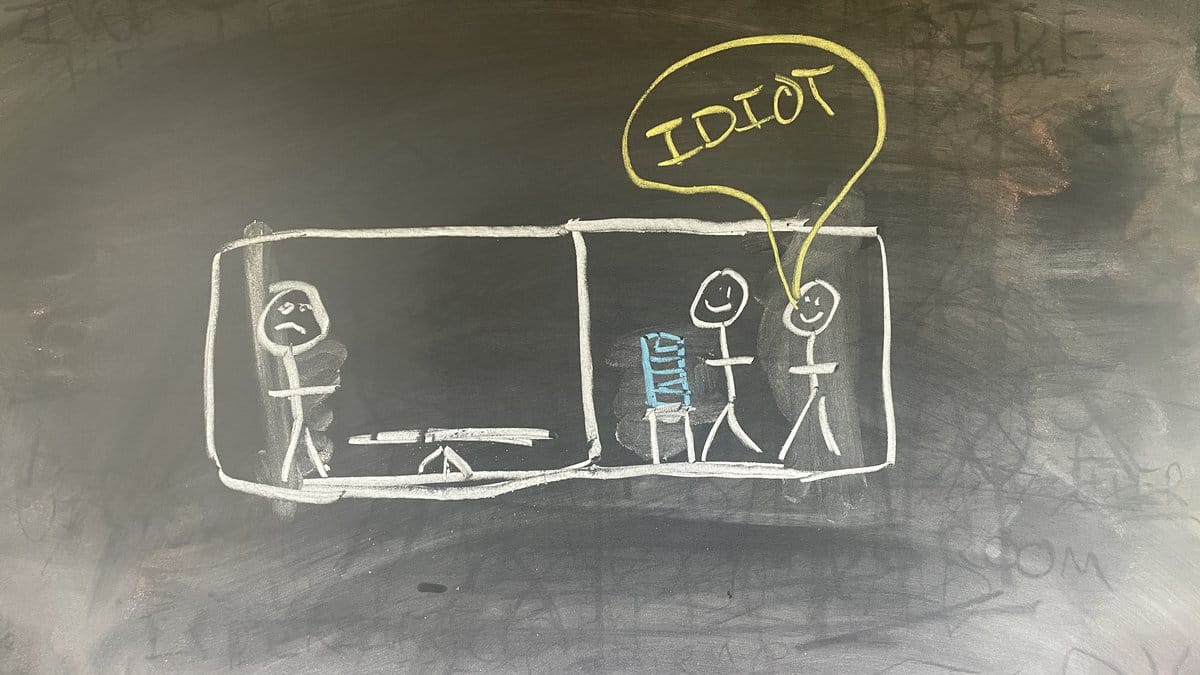
Your leadership team has gotten quiet, and you cannot quite tell whether that is a good sign or a bad one.
The meetings are smooth. Nobody is fighting. The same few problems come up, get discussed, and roll to the next agenda without much heat. People make the small calls and queue the big ones. From the outside it can look like a calm, aligned, well-run team. Sometimes it is. Often it is something else entirely: a team that has learned to manage around a leader who has frozen, and gone quiet because raising the hard things stopped being worth it.
You have probably diagnosed the quiet as a process problem. Or a prioritization problem. Or a meeting structure problem. You added agenda items, shortened the stand-ups, improved the documentation. The quiet is still there.
The problem is not the meeting. The problem is freeze.
The fast check, before the explanation
Before the nervous-system part, here is how to tell whether your team's quiet is alignment or freeze. Look for these four signals.
Action items that carry forward meeting after meeting without ever closing, not because they are hard to execute but because they require a call nobody is making.
Agenda items marked "discussion" that never reach a decision. The team talks around it, someone summarizes, someone adds a nuance, the leader says "let's keep thinking about this," and it reappears next time.
A project that has been in planning so long people have stopped asking when it launches. Somewhere in there a decision was required that nobody wanted to own, so the planning kept going in the direction of the decision without making it. That is not planning. It is freeze with slides.
And meetings that are consistently smooth with no real arguments. A leadership team that never disagrees is either extraordinarily aligned or quietly frozen. The first is rare. The second is common.
If you recognized two or more of those, the quiet is not alignment. Here is what is actually happening underneath it.
What the freeze response actually is
The autonomic nervous system has four responses to a perceived threat: fight, flight, freeze, and fawn. Fight activates aggression. Flight activates escape. Fawn, which I wrote about in The Fawn Response Is Destroying Your Sales Culture, responds by becoming more agreeable to whatever feels threatening. Freeze activates something older than all of them: immobility. In the animal world, freezing is what prey does when fighting and running are both off the table. The body goes still, the mind narrows, and the organism waits to see if the threat passes.
In humans, freeze is rarely physical stillness. It is cognitive and behavioral immobility dressed in rational language. The leader who genuinely cannot choose between two strategic options. The one who has been gathering information about the same decision for four months and still does not feel ready. The executive who says "I need to think about this more" every time a high-stakes question lands on them.
It also has a verbal signature, and it is sneaky, because it sounds responsible. "When I get X, I will." "Yeah, I just need to figure out Y first." It comes out sounding thoughtful and patient. Most of the time it is the spoken language of a cognitive freeze. This is the pattern that gets misfiled as the over-analyzer personality. But they are usually not over-analyzing. They are freezing, and analysis is the socially acceptable place to do it.
These are not people with a data problem or a missing framework. Their nervous system has registered a threat and answered with the one survival strategy that has no clean exit: stop moving.
There is a second disguise worth naming, because it looks like the opposite of freeze. Sometimes the frozen person is not still at all. They are extremely busy, just busy somewhere safe. Frozen on the decision that actually matters, they pour energy into a different area they can control completely, reorganizing a process, diving into the weeds of something already working, micromanaging a corner of the business that did not need them. It feels productive. One of my own lines for this is that busyness is a form of laziness. You act busy to avoid the thing you actually have to do. The hyper-activity is not the opposite of the freeze. It is the freeze, wearing a more flattering outfit.
How freeze spreads through a team
Here is what makes freeze so costly inside an organization. It is contagious. Not through anything physical, through behavioral mirroring.
When the most influential person in the room goes into freeze, the room reads it. The CEO gets a hard question from the board and goes quiet in a way that does not feel like composure, it feels like something is wrong. The founder stops communicating during a rough quarter and the silence travels downward. The VP says "we're still evaluating that" for the second month running and the team below them stops proposing anything new, because it is clear new things are not getting processed right now.
The team around a frozen leader rarely names what is happening. They navigate it. They clear the path. They stop bringing problems that might add to the weight they can feel in the room. They make the smaller decisions they can make without buy-in, and they put the harder ones into the queue everyone quietly knows is not moving.
That is the quiet you are seeing. It looks like a calm organization. It is an organization that has organized itself around the freeze response of whoever is at the top.
The conversations that don't happen
Freeze concentrates most visibly around the conversations with the highest relational stakes. The performance conversation with the longtime employee. The strategic conversation about the business line that has not worked in two years. The conversation with the co-founder about roles that need to change. The board conversation about the number that is not where it was supposed to be.
These do not happen because the nervous system of the person who needs to start them has registered the conversation itself as the threat. Not the outcome, the conversation. The moment of initiation. Picking up the phone, sending the calendar invite, walking in and saying the thing out loud.
That moment carries the full weight of everything the person fears might follow: conflict, rejection, the other person's pain, the loss of the relationship, the confirmation of something about themselves they are not ready to look at. Freeze protects against all of it. As long as the conversation never starts, none of those outcomes can happen.
The cost of that protection is real and it compounds. The underpeforming employee stays in the role another eighteen months. The failing business line absorbs resources for two more fiscal years until a new leader arrives and cuts it in a week. The co-founder dynamic erodes until it ends far more destructively than the conversation would have. The board learns about the number in a way that damages trust more than the truth would have.
Freeze is not saving anything. It is only deferring the cost while adding interest.
How freeze starves the leader of information
When an organization is navigating a frozen leader, information flow changes. People stop surfacing problems that require a decision. They filter what they bring up. They start managing the leader's cognitive load instead of giving the leader accurate information.
This creates a specific and dangerous loop. The leader, frozen partly because they do not feel they have enough information to act, receives less and less information as the team adapts to the freeze. The information gap widens. The freeze deepens. The team gets more protective. The cycle tightens.
I have worked with founders who believed their organization was healthy because nobody brought them hard problems. The reality was that the team had learned, accurately, that bringing hard problems to the founder created more stress than it resolved. So the problems stayed one level down. Sometimes the team solved them. More often they festered. By the time anything reached the founder, it had compounded to where the options were far narrower than they would have been six months earlier. The freeze that was supposedly waiting for clarity was actively destroying the clarity available.
Pause is not freeze
Not every slowdown is freeze. Some decisions genuinely benefit from more information. Some conversations need time to ripen. Some leaders process deliberately by design, and the deliberateness is strategic, not protective.
The difference is directionality. A considered pause moves toward a decision. It gathers specific information, consults specific perspectives, and works toward a defined resolution point with at least a rough timeline. Freeze moves away from the decision. It gathers information with no clear sense of what would be enough to act. It adds perspectives that expand the ambiguity rather than resolve it. It quietly repositions the decision as more complex than it seemed last quarter, which conveniently means it cannot be resolved this quarter either.
Here is the test. If you cannot articulate what would need to be true for you to make the call, you are probably not in a considered pause. You are in freeze. And the next move is not more information. It is identifying what specifically your nervous system is protecting you from by not moving.
What to do with this
The entry point into freeze is almost always the conversation you have been avoiding the longest. Not the hardest one in the abstract, the specific one you have been circling for the most time.
Pick it. Name it to yourself specifically. Not "the conversation with Sarah about performance." The specific sentence you have not said. The specific thing you already know and have not yet put into words in that person's presence.
Now ask why you have not said it. Not the rational version. The real one. What does your nervous system tell you will happen if you say it? Whose face do you see? What outcome are you protecting yourself from?
That answer is the constraint. Not Sarah's performance. Not the conversation. The specific thing your nervous system is keeping you from moving toward.
From there, the work is to separate the actual likely consequences of the conversation from the catastrophized version your nervous system is holding. Most of the time the real consequences are manageable. The conversation is survivable. The relationship, if it is worth keeping, adjusts. And the cost of not having it, counted honestly across all the time you have already spent not having it, is almost always larger than the conversation itself. Freeze is not free. It just makes you pay on a different schedule.
If you're a founder or CEO
If your team has gone quiet, resist the urge to fix it with structure. More agenda discipline will not move a team that has frozen around you. Start with the conversation you have personally been avoiding the longest, because your team's willingness to surface hard things almost never exceeds your own willingness to act on them. This is most of what constraint coaching with a founder actually is, not the meeting cadence on the surface but the specific decisions your nervous system has filed under "later" and the catastrophized outcomes keeping them there. When you start moving on the thing you have been frozen on, the team reads that too, and the quiet starts to lift from the top down.
If you're the one managing a frozen leader
You might be reading this not as the leader but as the person who works closest to one. If so, you already know the skills: you front-load the safe topics to build warmth before raising the hard thing, you pair difficult information with reassurance, you advocate for the leader's positions to the rest of the team to pre-empt the friction. These are sophisticated abilities, and they have probably made you valuable and well-liked. They are also the exact skills keeping the leader from ever encountering the accurate version of reality the organization is living in. This is not your fault, the system organized itself around a constraint and you adapted intelligently. But it is worth seeing clearly, because the most skilled navigators of a frozen leader are usually the ones who burn out or leave first, and their departure is often the first real signal that something has to change. If you have the standing to do it, the highest-leverage move is not better navigation. It is bringing one piece of accurate, unmanaged reality into the room and letting the leader sit with it. Sometimes that is the thing that breaks the pattern. Where it cannot come from inside, it is exactly what outside leadership facilitation is for.
Frequently asked questions
What is the freeze response and why does it show up in leadership? The freeze response is one of the autonomic nervous system's threat responses, defined by immobility rather than fight or flight. In leadership it shows up not as physical stillness but as cognitive and behavioral immobility: decisions that cannot be made, conversations that cannot be started, information that cannot be processed and acted on. It activates when the perceived cost of moving feels higher than the cost of staying still, and it is more common in high-stakes leadership than most organizational frameworks acknowledge.
Why has my leadership team gone quiet? A quiet leadership team is not always an aligned one. Often the team has learned to manage around a leader who has frozen on a set of decisions, and has gone quiet because surfacing hard problems creates more stress than it resolves. They make the small calls, queue the big ones, and stop raising things that would add weight to the room. The quiet reads as calm but is actually the team organizing itself around a constraint at the top.
How do you tell the difference between a considered pause and a freeze response? A considered pause is directional. It gathers specific information toward a defined resolution point, with a rough timeline and a clear sense of what would be enough to act. Freeze is not directional. It keeps expanding what would be needed to move, adds perspectives without resolving ambiguity, and repositions the decision as progressively more complex. If you cannot articulate what would need to be true for you to make the call, you are likely in freeze rather than deliberation.
Can one leader's freeze response affect the whole organization? Yes, significantly. When the most influential person in an organization freezes, the team organizes to navigate around it rather than name it. Information flow narrows, fewer hard problems reach the leader, and decision queues back up. The team develops sophisticated skills for managing the leader's cognitive load, which deepens the information gap the freeze was already creating. By the time the leader recognizes it, the compounded cost is usually far larger than the original decision would have been.
How do you start breaking a freeze pattern? Identify the specific conversation you have been avoiding the longest and name explicitly what your nervous system says will happen if you have it. The gap between that catastrophized outcome and the actual likely consequence is where the work lives. Most freeze patterns break not through more information but through the leader being willing to see what they are protecting themselves from and choosing to act anyway. If you are on the team around a frozen leader, the parallel move is bringing one piece of accurate, unmanaged reality into the room instead of smoothing it over.
So much respect.