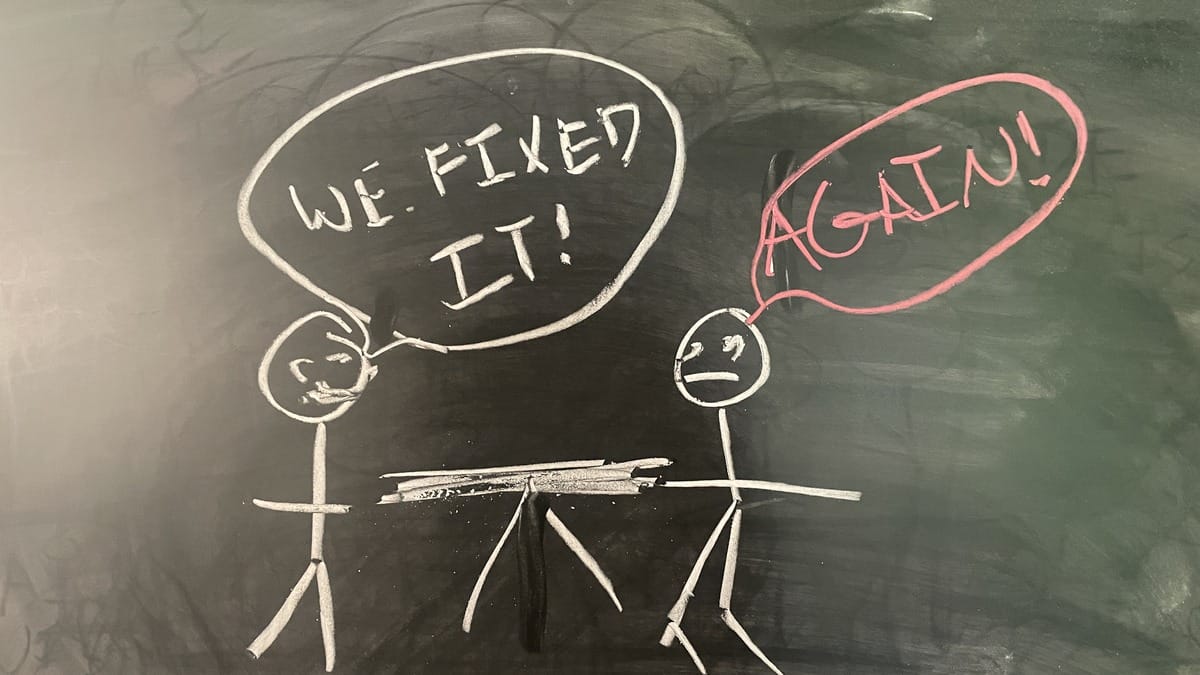
Your leadership team is not failing to name the problem. They name it every quarter. They have named it, in that room, in some form, for three years.
Naming it is the ritual. It feels like progress because it feels like honesty, and it is honest. It is also the reason nothing moves.
The constraint is not that the team cannot see the monster. The constraint is that the monster gets described in a sentence nobody in the room is standing inside of.
Why naming the constraint is not the same as owning it
Listen to how leadership teams actually state their problems.
We cannot keep our people. We cannot hire the right people. Our team does not follow the systems. We are not closing large accounts. We lost one of our biggest clients. The big account did not buy the new product line. The warehouse is constantly behind. We have too many returns. Marketing is not producing leads. We need the right people in the right seats. Managers are not doing what they are supposed to.
Every one of those is a real problem. Every one of them gets said out loud by serious people who care.
And not one of them has anybody in the room inside the sentence.
The people who will not stay are not there. The managers who are not performing are not there. The account that did not buy is not there. Marketing, as an abstraction, is not there. Each statement locates the problem somewhere outside the four walls, which means the room has just spent its most expensive hour of the quarter discussing something it has no access to.
You cannot fix a sentence you are not in. So the team loops.
Why leadership teams locate every problem outside the room
I have a line I use for this. If it is my fault, it is my circumstance. If it is your fault, it is your character.
Watch what that does in a leadership meeting. When I miss the number, I had circumstances. The market shifted, the client changed scope, the data came late, I inherited a mess. All true, usually. When somebody else misses the number, they are careless, or disengaged, or not built for this. Character.
Every sentence on that list above is a character verdict on somebody who is not in the room to offer their circumstances. The managers are not doing what they are supposed to is a judgment about who those managers are. If you put those managers in the room, they would immediately have circumstances, and most of them would be legitimate.
This is not a flaw in your team. It is how ego works, in everyone, by default. The discipline is doing the opposite on purpose: taking character for yourself and letting the world's part stay the world's part. Almost nobody does that without help, because the wiring runs the other direction.
How to state a constraint your team can actually solve
When I facilitate, I open with a principle that is not mine and has never once been rejected in a room. Every problem is a leadership problem.
Then one rule. Do not complain about your team. It adds nothing here. If your team is not performing, you are not managing them well. If you do not have the right team, you hired the wrong people. That is not cruelty, it is the only version of the conversation that has a lever in it.
Nobody argues. That part surprises people who have not run these rooms. The principle lands immediately and everyone owns it, because owning a principle is free.
The default comes back the moment we get into the actual constraints, because that is where owning it costs something. So I have to keep pulling people back to articulating the constraint inside the principle.
Weak: we keep losing clients because the team keeps messing up the project.
Strong: I have not properly trained our development team on the QA/QC process, which is causing downstream errors in staging, and the client is catching those mistakes in the production environment.
Look at what changed. The strong version has a person in it. An action that person did not take. A mechanism. And a location where it surfaces. One of those sentences you can start on Monday morning. The other one you can complain about for three years, and teams do.
That is the whole loop in one comparison. The problem gets stated generally. The team then builds a specific solution to a general statement, and the specific solution does not touch the general thing, so nothing moves. The problem was stated at the wrong altitude, and every hour spent solving it was aimed at empty air.
Why quarterly breakthroughs fizzle before the next session
Even a room that gets it right runs into the thing nobody plans for.
You spend two or three days offsite doing real work. Something cracks open. The team is aligned, the constraint is named properly, everyone is in.
Then you go back. Your inbox is full. Your team has a stack of questions that piled up while you were gone. Your family has lost patience because you have been away, or late, or wrecked when you got home. That is the reality slap, and the natural human response to it is to hunker down in the familiar. Not because anyone is lazy. Because the familiar is safe and you are out of capacity.
The default wins on speed. If the work you committed to does not produce visible progress fast enough, the familiar reabsorbs it, and by the next session the momentum is gone.
Then the next session arrives and it feels different. New economy, new pressure, some new people in the room, better energy. It genuinely feels like this is the time we crack it. The approach is identical. So is the result.
That is why I start constraint work with one or two easy wins. Not because the easy ones matter most. Because they need solving anyway and they produce visible movement fast enough to outrun the default. Then the big one gets broken into pieces small enough that progress keeps showing up between sessions. Progress is what beats the reality slap. Not conviction.
What unsolved constraints cost a company over three years
The loop is not neutral. It compounds, and the compounding is the part that kills companies.
Your A players leave first. They have options, and they can feel the difference between a room that solves things and a room that performs solving. They do not usually announce that as the reason.
Then the silos harden, and this is the expensive one. Every quarter the room fails to solve a collective problem, each individual collects one more piece of evidence that the collective cannot solve collective problems. So they stop bringing anything real to it. They build a safety den inside their own function, where at least they control the outcome. That is not a structural problem you can reorg your way out of. It is an accumulated evidence problem, and the evidence is accurate.
What is left is a company full of competent people protecting their own territory, and a leadership team that never once unlocks what the collective could actually do. That is the missed opportunity nobody puts on a P&L. Not the constraint that stayed. The market you never got to go take, because the room could not solve one real thing together and everyone quietly learned to stop trying.
If you're a CEO whose leadership team keeps circling the same issue
Take the problem your team has named the most times. Not the most urgent one, the most repeated one.
Write down how it gets said in the room. Then check whether anyone present is in the sentence. If the subject is the team, the market, the managers, or a department, nobody is.
Now rewrite it with you in it. A person, an action you did not take, a mechanism, and a place where it surfaces. If you cannot write that sentence, that is the finding. It means the room has been generating discussion about something it has no access to, and it will keep doing that for as long as the sentence stays the way it is.
If you're an ED running a nonprofit at five to fifty million in giving
Mission gives the loop somewhere better to hide. The problem statements get moral, which makes them feel more honest and makes them harder to own. Funders do not understand our model. The community is not showing up. The board is not engaged. Our staff is burned out.
Same architecture. Nobody in the room is in any of those sentences.
The rewrite is the same and it stings the same. I have not built a case that translates our model to the funders we are targeting. I have not given the board a real role, so they behave like a fiduciary body. I have designed roles that require sacrifice to succeed. Those are workable Monday. The moral version is not, and it will outlast your tenure if you let it.
Frequently asked questions
Why does my leadership team keep discussing the same problem without solving it? Usually because the problem is stated in a sentence nobody in the room is inside of. Statements like we cannot keep our people or managers are not doing what they are supposed to locate the problem outside the room, which means the team has no lever on it. The team then builds a specific solution to a generally stated problem, the solution does not touch the general thing, and nothing moves. The problem was named at the wrong altitude.
How do you get a leadership team to take ownership of constraints? Open with the principle that every problem is a leadership problem, and rule out complaining about the team. Almost nobody argues with the principle, because agreeing to a principle costs nothing. The work is holding the line when the team articulates specific constraints, which is where ownership gets expensive. Every constraint has to be restated with a person, an action they did not take, a mechanism, and a place where it surfaces.
What is the difference between naming a constraint and owning it? Naming is general and locates the cause elsewhere: the team keeps messing up projects. Owning is specific and puts the speaker in the sentence: I have not trained the development team on the QA/QC process, which is causing errors in staging that clients are catching in production. The first can be discussed indefinitely. The second can be started Monday.
Why do leadership offsites lose momentum after a few weeks? Because of what happens when people go back. The inbox is full, the team has questions, and the family is out of patience. The natural response to that reality slap is to retreat into the familiar, which is safe and cheap. If the committed work does not produce visible progress quickly, the default reabsorbs it. Starting with one or two easy wins and breaking the big constraint into small pieces keeps progress visible enough to outrun that pull.
What does it cost a company when the leadership team cannot solve problems together? The A players leave first, because they can tell the difference between a room that solves things and a room that performs solving. Then silos harden, because each failed quarter is more evidence that the collective cannot solve collective problems, so people stop bringing anything real to it and build safety inside their own function. The largest cost is never on the P&L. It is the market you never went and took, because the room never unlocked what the group could actually do together.
Your team is not stuck because the problem is hard. It is stuck because the problem, as stated, has no one accountable inside it, and a room cannot move something it cannot reach. The work is not more honesty about what is broken. The work is rewriting the sentence until somebody in the room is standing in it, and then making progress fast enough that the familiar does not take it back before the next time you meet.
Take this if it serves you.
Much Respect,
-bryan