Looking for a business coach is a great step. But the lazy framing can cost you in the end. Not just the hard cost of the coach, but the longer cost of not getting the right coaching at the right time.
A business has a lot of parts. Finance, which has its own layers. Operations. Market share. Human capital management. Systems and processes. Tech. And much more than that. Not to mention all the soft skills few people talk about. Ego. Toxicity. The childhood trauma that is surfacing in every leadership meeting, from you as the founder or from people on your team. Nobody is great at all of that, and no single coach covers all of it either.
So "I need a business coach" is the right instinct pointed at too wide a target. Being intentional about what you need, when you need it, and vetting who you put around you to close that gap, that is the framework that actually accelerates your goals.
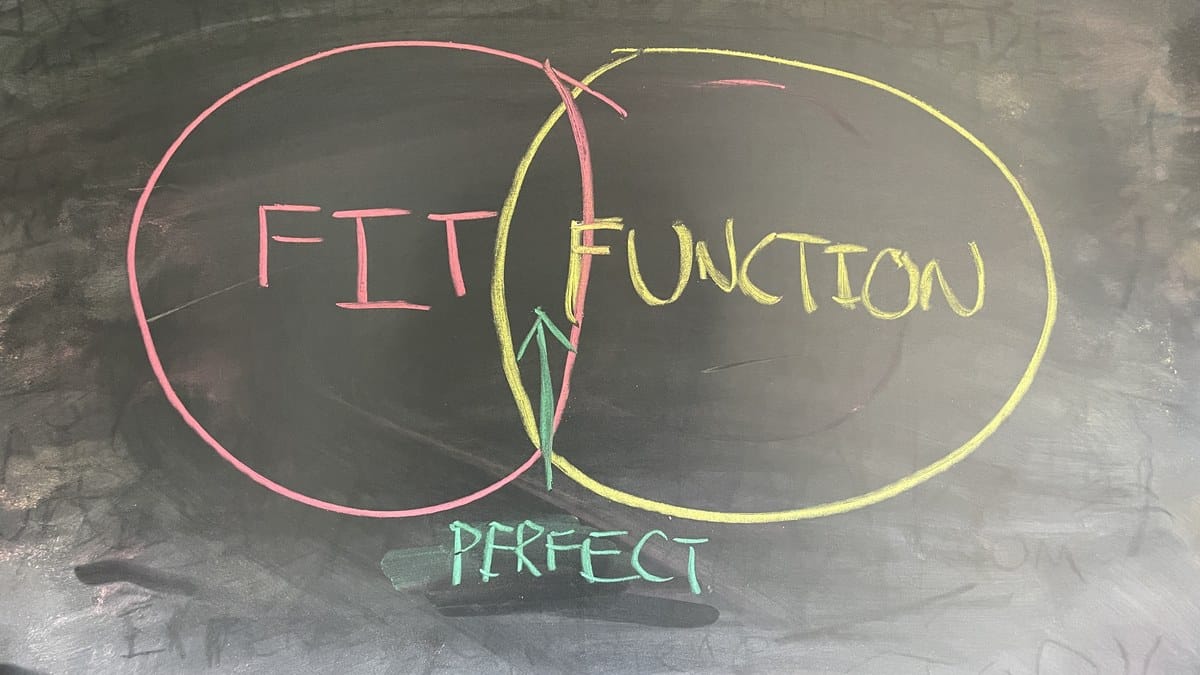
It comes down to two questions. Do we fit, and does this person serve the function I need right now. Fit and function. Everything else is downstream.
Fit: the chemistry between you and your coach
Fit is not the soft part. It is the part that decides whether any of the work happens at all. A coach you cannot be fully honest with is a coach who cannot see your blind spots, and a coach who cannot see your blind spots is just an expensive conversation. The whole engine runs on whether you can drop the public version of yourself in the room and tell the truth.
So I evaluate fit on who the person actually is, not their resume. Here is the exercise I run on myself, and I would run it on anyone you are considering.
I have been married over twenty years and I have two kids. I love my family, and my priority is not my life, it is our life. So I want a coach who loves their family too. That is a nonnegotiable for me. I am not saying everyone should weigh it the way I do. I am saying name the things that are nonnegotiable for you, because fit is personal by definition.
I love endurance sports. It forces me to prioritize training I would otherwise skip, because I will always give my time to work or family first. A race on the calendar gets me up in the morning. I want a coach who guards their own health the same way, because someone who has let that go entirely is going to struggle to coach me toward balance I can feel.
I do not take life or work too seriously. Nothing is really that important, in the way that lets you make hard calls without strangling them. A coach who is wound tight is going to grate on me inside a month. A different founder would find my register too loose. That is not a flaw on either side. It is fit, and fit is supposed to filter.
Sometimes the person who serves your business best is not a business coach at all. The thing in the way could be you, and the right hire today may be a good therapist. I wrote a whole piece on why I keep the coaches I keep, and the inner work turned out to be the most leveraged of all of them. Do not let the word "business" on the search narrow you out of the help you actually need.
Function: the right coach for your current stage
Here is the part most people get wrong. You are not hiring a "finance coach." You are hiring someone who has run the specific play your stage of the business needs right now. The title is the same across stages. The job is completely different. A coach who is brilliant at startup projections can be the wrong pick for a company validating its value before a private equity rasie. Same seat, wrong play.
Here are a few examples of how the same coaching seat changes with the stage of the business. There are hundreds more, but these give you a way to think about matching your stage to the right coach.
Finance. At a startup, a financial coach is about projected value, the story of what this becomes. At a company prepping for PE, it flips to validating current value, with a story that backs the projected growth. Two distinct stories, two distinct people.
Systems. At three million, a systems coach is usually working human efficiency, managing mostly manual processes with supportive tech and AI layered in. At thirty or a hundred million deploying ERP, the work is capital management, phased operational deployment, cultural adaptation, technical support, and compressing the timeline so the investment returns faster. Same seat, entirely different job.
Market share. At three million, the coach helps you build the brand story itself, from close to nothing. At thirty million, the work is establishing authority, a story that increases your category authority with people who already know you exist.
Value and strategy. At three million, the work is articulating the acute value proposition so the business knows where to apply capital and where to spend the majority of its energy. At a hundred million, it is exploring customer-adjacent value, the kind of exploration that leads to strategic M&A.
Find the version of this that matches where you are standing. That is your function. Now you know what you are actually shopping for, which means you can evaluate the person in front of you against a real need instead of a vague title. I built a whole map of the seats a founder needs filled in a separate piece on the coaching stack, and function is how you fill each seat with the right human.
How I actually run fit and function
Here is how this works when a CEO and I start talking, because the two questions are not just for hiring me, they are how I structure the engagement itself.
I like to set up a three month engagement to find out if the chemistry is real. We can fall in love on the first call. That happens. But you do not actually know if you work well together until you have moved through a real event or situation as a pair. The first call tells you almost nothing. The first hard thing tells you everything. Past three months, we can usually see clearly whether the chemistry is there or it is not.
And it is completely okay if it is not. So many people say "I tried a coach" or "I tried therapy," when what actually happened is they tried one. Sometimes the chemistry was a bad fit, and that does not mean the modality is flawed. Fit is specific to two people. A bad pairing is not a verdict on the whole idea of being coached.
Then we get to function. Based on the core constraints the CEO and the executive team are actually facing, am I the right person to coach them through it. This is where fit extends into execution. If the company's biggest constraint is well beyond my experience, I do two things. I tell them I am glad to stay on for the leadership, management, and change-management work, and to solve this specific constraint, bring in the right specialist. A CFO. An M&A specialist. A tech specialist. I will always recommend both, me on the human side and a specialist on the technical one. But if there is only room for one, get the specialist.
No hard feelings. A great coach wants to be part of a winning equation, not a guaranteed stalled formula. I have found that being radically open about alignment on both fit and function is exactly what produces the strong, long-term relationships. Honesty about whether you are the right coach is the thing that makes people trust you when you say you are.
The perfect business coach
Fit without function gives you a coach you love who cannot move the thing that is stuck. Function without fit gives you exactly the right expertise wrapped in a person you will never be fully honest with, which means the expertise never lands. You need both. Do we fit, and does this relationship serve the function I need to advance from where I am right now.
That is the whole pick. Everything else, the credentials, the testimonials, the website, is downstream of those two questions.
If you are a founder building a company around a story you believe in, run the fit exercise on yourself first. You cannot evaluate fit in someone else until you have named what is nonnegotiable for you. Then find where your business is actually standing, and hire the person who has run that exact play, not the one with the most impressive general title.
If you are an executive director carrying a mission, a team, and a board, the function map shifts to your world, fundraising, governance, program scale, but the logic holds exactly. Name the stage you are in, name the function you need, and protect fit as fiercely as competence, because the relationship only works if you can be fully honest inside it.
So much respect.
Frequently asked questions
Q: How do I choose the right business coach? A: Ask two questions. Do we fit, meaning can you be fully honest with this person, and does this person serve the function your business needs right now. Fit decides whether the work happens. Function decides whether it moves the thing that is actually stuck.
Q: Should I hire a coach based on their credentials? A: Credentials are downstream. A coach who is excellent at one stage of a business can be the wrong pick at another stage, even in the same domain. Name the function your stage needs, then evaluate whether this specific person has run that specific play, not whether their title matches the word in your search.
Q: What is the difference between fit and function when picking a coach? A: Fit is whether you can be fully honest with the person, built on chemistry, values, and how they live. Function is whether the relationship serves what your business needs to advance from its current stage. You need both. Fit without function is a coach you like who cannot help. Function without fit is help you will never let in.
Q: How do I know what kind of coach I actually need? A: Match your stage to the work. The same seat, finance, systems, market share, strategy, needs a completely different coach at three million than at thirty or a hundred million. Naming where you are standing tells you the function to shop for.
Q: How long should a coaching engagement be before I know it is working? A: Give it about three months. You can connect on the first call, but you do not learn whether you actually work well together until you have moved through a real situation as a pair. After three months the chemistry is usually clear. If it is not there, that is a fit problem with that one person, not proof that coaching does not work for you.