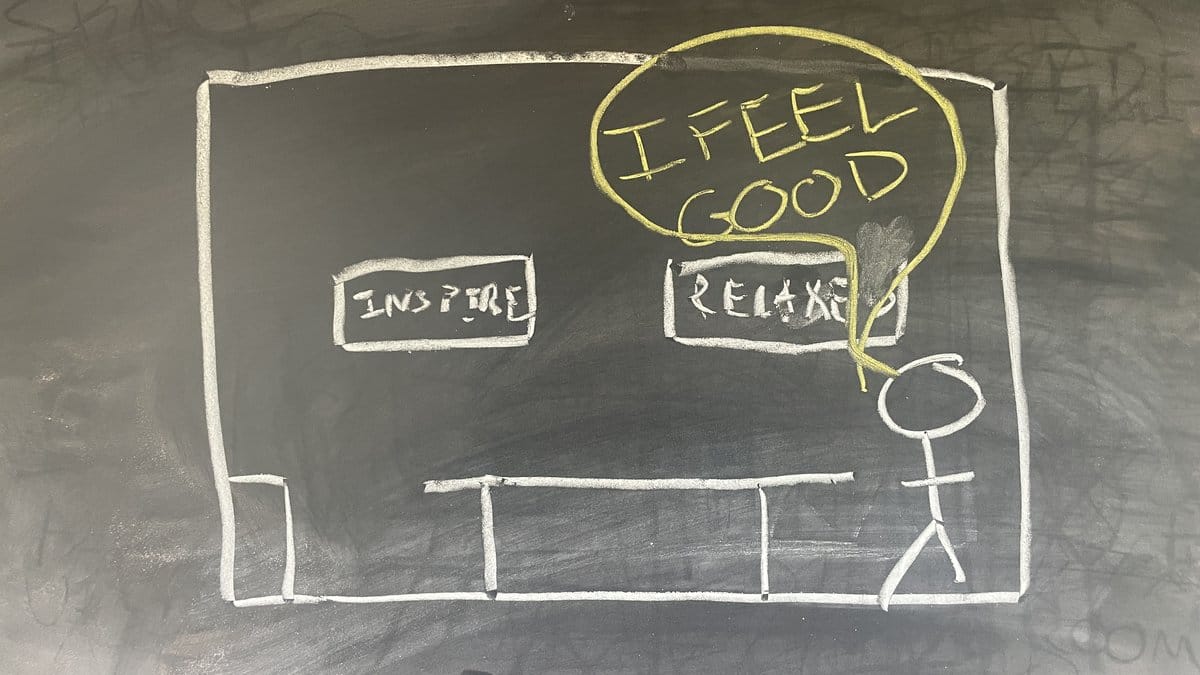
I have been in a lot of rooms.
Conference rooms in downtown office towers. Community centers with folding chairs and harsh fluorescent lighting. Hotel ballrooms set for eight people in a space designed for eighty. Board rooms where the furniture says power and the arrangement says hierarchy, and the people sitting in it are supposed to think freely, which the furniture and the arrangement make nearly impossible.
I have walked into rooms and felt something settle in me, and I have walked into rooms and felt something tighten. I have felt that my whole life. Long before I could have told you why, I knew that rooms had an energy, that some spaces opened people up and some closed them down, and that the difference was not in my head. Space has been my thing since I was a kid building studios in a basement. I always knew it mattered. What I did not have, for most of my life, was language for it.
That is what a therapist gave me. Not the insight, I already had the insight in my body. The words.
Over a long, intensive stretch of inner work, a couple of years of it, the spiritual side and the scientific side of this finally came together for me. On one side, energy, vibration, the felt sense of a space, the thing I had always trusted intuitively and never named. On the other, the actual mechanisms: environmental psychology, the way light and arrangement and sound and scent move through the nervous system. The deep work, and the way she worked, gave the intuition a vocabulary and a set of frameworks. A thing I had been doing wordlessly my whole life became a thing I could name, document, and direct.
It eventually crystallized into a single sentence I have never been able to set down. She never put it exactly this way. This is my own reframe of what those years taught me:
Every room is already making a decision about who gets to think clearly in it.
What that sentence actually means
I sat with that sentence for a while before it fully landed.
What it points at is something environmental psychologists have documented extensively and most people experience without ever naming. The physical space you are in shapes the quality of your thinking. The arrangement of furniture determines who has authority in the conversation. The lighting affects alertness and emotional openness. The acoustics determine whether the room feels intimate or exposed. The temperature influences the willingness to take cognitive risks. The presence or absence of natural light, the quality of the air, the degree of visual distraction, the smell of the space: all of it registers below conscious awareness, and all of it shapes what the people in the room are capable of in that particular hour.
This was the science catching up to what I had always felt. The room is not a neutral container. The room is an active participant in the conversation happening inside it.
For a therapist, this is not a metaphor. It is a clinical consideration. The arrangement of the chairs relative to each other, the softness of the lighting, the objects that create a sense of safety and specificity, the absence of a desk as a barrier between therapist and client. These are deliberate choices the good ones make, because the quality of the work depends on the quality of the container. Watching someone practice that intentionally, and name it, was part of what gave my own instinct its language.
The principle was never only about therapy rooms. It applies to every room where thinking happens, including the rooms where I do my work.
How it changed what I do
I had been facilitating leadership conversations for years, working off that same intuition about rooms. But before the deep work, the intuition was just a feeling. A strong one, one I trusted, but not a framework. I could sense that some spaces were harder to work in than others. I could not yet tell you the mechanisms, or build a session around them on purpose.
Once the instinct had words, I started doing it deliberately. I arrive early now and change the room before anyone else gets there. Not theatrical changes. Small, specific ones. Moving tables out of rows into circles or horseshoes. Diffusing the overhead lighting where the venue allows it. Putting music on in the transition time before we start, because music before a working session does something specific to the emotional availability of the people walking in. It lowers the performance register. It signals that this is not a presentation, it is a conversation.
I bring things into rooms now. A specific scent I use consistently across sessions, because smell is processed through the limbic system, the emotional center of the brain, and a consistent scent builds a Pavloivian association with the kind of thinking I am trying to create. I think about where I position myself and what that position communicates to the people sitting there. I think about what is on the walls, what people see when they look up from their notes, whether the visual information in the room is aligned or misaligned with the kind of thinking the session requires.
None of this replaces the quality of the facilitation. But the same content, delivered into a room prepared deliberately, produces something different than the same content delivered into a room nobody touched. The room was doing work the whole time. I just had to learn to direct it.
The principle underneath the practice
Stripped to its core, the lesson is this: environment is not the context for the work. Environment is part of the work.
That sounds simple. It is not widely practiced. Most leaders, facilitators, and organizations treat the space as given. The conference room is the conference room. The annual retreat is at whatever hotel the planning committee booked. The weekly meeting is in the same room it has always been in, arranged the way it has always been arranged, because that is where the projector is and nobody has asked whether the projector wall should decide the direction the whole conversation faces.
The cost is real. A leadership team trying to have an honest conversation about strategy in a room arranged like a boardroom, projector at one end, twelve chairs along two sides of a long table, is working against the room. The architecture says presentation. The conversation requires dialogue. The mismatch is doing work on the people whether they know it or not.
I have run the same session content in a circle with natural light and in a standard hotel conference room and gotten measurably different outputs. The difference is not dramatic in any single moment. Over a six-hour working session, the accumulation of small environmental decisions either supports or taxes the cognitive and emotional work required. The room that supports it produces a better outcome. The room that taxes it produces one that is slightly flatter, slightly more defended, slightly less honest than the same people in a different configuration would have produced.
The leader who designs the room with intention is not being precious. They are doing exactly what the therapist does. They are making the container work for the conversation, instead of letting the conversation work against the container.
Where it started
The recording studios I built growing up are where this became mine in the first place. The rooms I put together in my parents' basement were not professional spaces, but they were intentional ones, and building them is where I first fell for the idea that space is everything. The placement of the instruments, the treatment of the walls, the path the sound would take, all of it meant thinking about the environment before the work started. The work happened inside the environment I had built, and the quality of the work was shaped by the quality of that environment in ways I could hear directly. That was the beginning of a lifelong attention to space. (I wrote about that basement in The Basement Studio.)
For a long time I held that as one thing and my facilitation work as another, building with your hands versus running leadership conversations. The deep work collapsed the distance. They are the same problem. You are creating the conditions under which something important happens. The conditions are not incidental. They are causal. I had known that since the basement. I just finally had the language to say it.
Where this applies beyond workshops
The principle extends past facilitation into every regular cadence of organizational life.
The way your weekly team meeting is arranged. The layout of your one-on-ones. Whether you hold performance conversations at a desk, in a coffee shop, or on a walk. Whether your leadership retreats happen in the same office the team sits in every other week or somewhere different enough to shift the register.
Every one of those is an environmental design decision, and most leaders are making them by default. The meeting is in the conference room because that is where meetings happen. The one-on-one is at the desk because that is where the desk is. The annual planning session is at the hotel because the hotel has the rooms and the audio-visual and the catering.
Those defaults are not neutral. The conference room for every meeting tells the team that all conversations are created equal, which is not true. The desk in every one-on-one tells the direct report that authority is physically present in the conversation, which may or may not serve the relationship. The same hotel every year tells the leadership team that this year's thinking will happen inside the same frame as last year's. You can override the defaults deliberately. The question is whether you are thinking about them at all.
This is the precondition for the conversations leadership teams most need to have. The honest assessment of where the company is and where it needs to go. The talk about strategic direction, about the real constraints, about the things that feel risky to say in front of colleagues and a boss. Those do not reliably happen on an average Tuesday morning in a fluorescent-lit conference room. Environment design is not a substitute for the skill it takes to hold those conversations, but it is the precondition for them. A room prepared to lower the performance register, to create safety, to signal that this time is different, is doing something before the first word that the facilitator's skill alone cannot do once the session is underway. You cannot talk people into a certain quality of thinking. You can build the space that allows it. (This is the practice I unpack in The Environment Is the Intervention.)
What to do with this
Pick one recurring meeting in your organization that matters.
Before the next one, change one thing about the space. Not everything. One thing. Move the chairs into a different arrangement. Change the lighting if you can. Start ten minutes early and put something on the audio system. Take the chairs off one side of the table so the room stops signaling rows and starts signaling conversation.
Then notice what happens. Not dramatically. Just pay attention to whether the quality of the thinking in the room is different than usual.
You are not looking for proof. You are looking for data. One experiment in one meeting is not a conclusion. It is the start of treating the room as a design problem instead of a given.
Every room is already making a decision about who gets to think clearly in it. The only question is whether you are making that decision deliberately or letting the default make it for you.
If you're a leader or facilitator
You do not need a renovation budget or a design degree to apply this. You need to stop treating the room as fixed. Before your next high-stakes session, get there early and change one structural thing, the seating geometry, the light, the sound in the doorway minutes. The reason this is worth your time is that you cannot coach, facilitate, or lead your way out of a room that is working against you. The container sets the ceiling on the conversation. Most leaders pour all their preparation into content and none into the space the content lands in. Closing that gap is some of the cheapest, highest-leverage leadership facilitation work available, and almost nobody does it.
If you're a nonprofit executive director
For nonprofits the environment question shows up most visibly in two places: donor meetings and board sessions. A donor meeting in a spare, functional office is shaped by what that office says, "we are efficient," and sometimes also "we are under-resourced." A warm, intentional office that reflects the mission visually says "this organization has coherent values and has applied them here." The environment is making an argument before anyone speaks. And a board that meets in the same conference room every month is architecturally asking for the same quality of thinking every month. Moving a board retreat off-site, into a different space with different arrangements and sensory inputs, is not a luxury. It is a design decision that changes what the board is capable of thinking in that session. Investing deliberately in the working environment, within whatever budget you have, is not indulgent. It is applying the same principle a good therapist applies: the container shapes the conversation, and designing the container is doing the work.
Frequently asked questions
How does the physical environment affect thinking and decision-making? Research in environmental psychology shows that physical space shapes cognitive and emotional states in measurable ways. Lighting affects alertness and emotional openness. Room arrangement determines who holds authority in a conversation. Acoustics, temperature, scent, and visual information all register below conscious awareness and influence what people in the room are capable of in a given hour. The room is an active participant in the conversation, not a neutral container for it.
Why do leadership facilitators pay attention to room design? Because the physical container of a conversation either supports or taxes the cognitive and emotional work required in it. A leadership team trying to have an honest dialogue in a room arranged for presentations is working against the architecture. Deliberate environmental design, adjusting arrangement, lighting, acoustics, and sensory inputs, produces measurably different outputs from the same people working through the same content.
What does it mean that environment is the intervention? It means the space where thinking happens is not neutral context but an active variable in the quality of that thinking. Leaders and facilitators who treat the room as a design problem, making deliberate choices about arrangement, light, sound, and sensory inputs, are doing work that shapes the conversation before anyone speaks. The design of the container is part of the facilitation itself.
How can leaders use environment to improve meeting quality? Start with one recurring meeting that matters. Change one element of the space before the next session: the seating arrangement, the lighting, the audio in the transition time before the meeting, or the removal of furniture that signals hierarchy when dialogue is required. Notice what changes in the quality of the thinking, then build from there. The goal is to start treating the room as something you design rather than something you inherit.
How does meeting environment affect psychological safety? Room arrangement communicates authority and the expected register of a conversation before anyone speaks. A space arranged hierarchically signals that authority is the operating variable. A space arranged as a circle or conversation cluster signals that contribution is. Teams read these signals and adjust how much cognitive risk they will take accordingly. Environment is one of the most underused tools for building the psychological safety that honest, high-quality organizational thinking depends on.
So much respect.