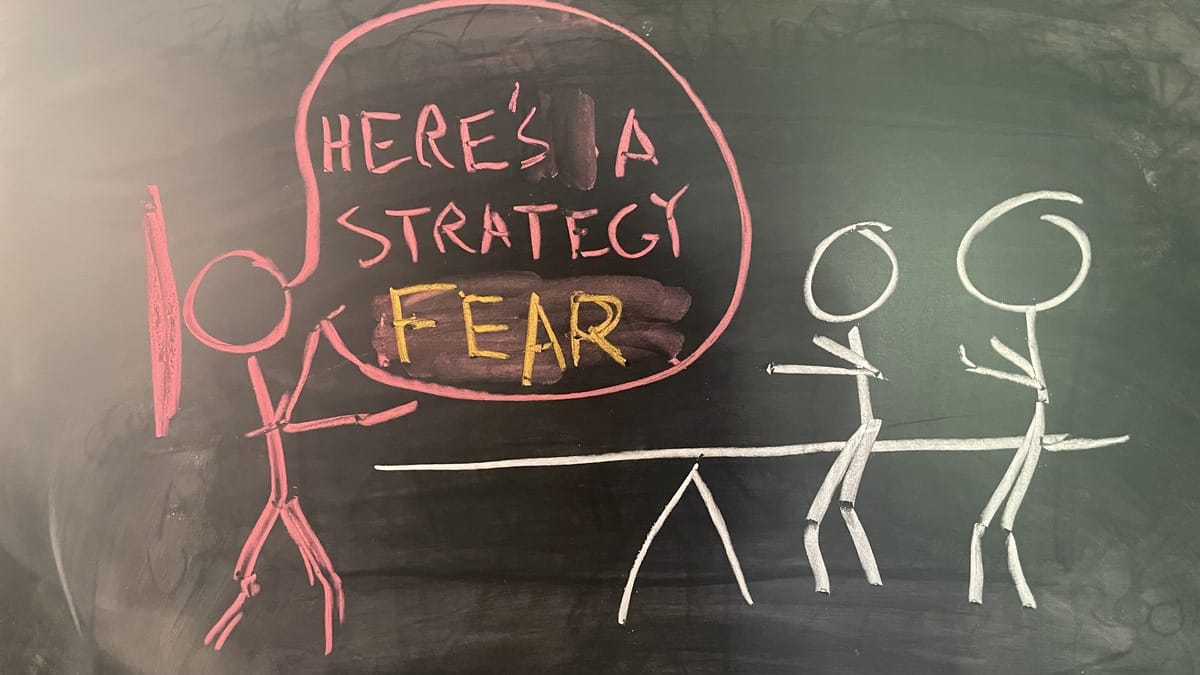
We grew twenty percent last year. I believe we can grow twenty-five percent this year.
That is not a strategy. There is no mechanism in it. No constraint named. No thesis about the market, the customer, or the thing standing in the way. It is last year's number with a little more on top, said out loud in a room, and the reason it exists is so the person saying it gets to be someone who says ambitious things.
It is a mood with a decimal point.
Fear and strategy are indistinguishable from inside the head of the person making the decision. Both produce a reason. Both sound like judgment. The difference is what is driving them, and you cannot tell from the sentence itself.
What founders are actually afraid of losing
Not loss. Not failure. Those are the words people use because they are the acceptable ones.
The read I get from leaders, over and over, is the fear of becoming irrelevant. If the business goes away, they stop being the hero of the room. The people who gather in their presence stop gathering. The thing that makes them the person everybody turns to look at is gone, and what is left is a man in a house with nobody asking him anything.
That is the fear. Everything else is a costume it wears.
And it does not stay inside the founder's head. It comes out as strategy. The projected anxiety turns into desperate goals and cliché slogans, and the whole company gets organized around a number that exists to make one person feel like he still matters.
How fear shows up as growth goals and leadership slogans
I just want people to take ownership.
I believe each of you have the capabilities.
Both of those get said by CEOs who personally review every decision that leaves the building. And they mean it. That is what makes it so strange to watch. He believes each of them has the capabilities. He also cannot stop touching the work, and the room hears the second sentence, the one he is saying with his calendar, and that is the one they act on.
The slogans are confessions. Every one of them describes the exact thing the leader's own behavior prevents. Ownership is not withheld by employees. It gets absorbed by founders, and then requested back, in a meeting, as a value.
Why your team does not take ownership when you ask for it
Watch the faces when a CEO says he wants more ownership. Nothing moves. Everyone nods. Then they walk out and say the real thing to each other in the parking lot.
We have been working our asses off. You cannot see that? I do not even own this company. You do. So do not stand up there and ask me to act like an owner while you keep every decision. You do not see me.
Both sides are right. He is right that ownership is not happening. They are right that they are killing themselves. Neither one is lying and neither one is the problem. He is scared of becoming irrelevant so he asks for ownership, and the people who have been carrying the thing hear that their work is invisible. Same wound. Two people afraid of the same thing, aimed at each other across a conference table.
Why fear-based leaders think they are being data-driven
Fear does something more expensive than distort a decision. It curates the evidence.
A leader making decisions from fear is not just protecting the wrong thing. He is filtering what he is willing to receive. The market signal that says move gets read through what could go wrong instead of what could go right. The team member who raises the hard question gets an answer that closes the conversation. The advisor who challenges the assumption gets heard politely and not acted on.
So the information environment starts matching the fear. Data that confirms caution gets amplified. Data that would support a bold move gets minimized. And the leader ends up making evidence-based decisions inside an evidence set his own avoidance selected, which feels exactly like rigor from the inside.
That is why you cannot think your way out of this one. The thinking is happening in a room the fear built.
How to tell the difference between prudence and fear in a business decision
Prudence and fear produce identical output. Caution. The difference is what is driving it. Prudence is driven by evidence that the risk is not worth the return. Fear is driven by the discomfort of the loss, regardless of what the evidence says.
The diagnostic is one question. If the fear of loss were completely absent, what would the evidence tell me to do?
That is hard to answer honestly, because the fear is never fully absent. But you can approximate it. Ask someone with no emotional skin in the game. Look at what leaders you respect did in situations close enough to yours. Look at the evidence that is actually present, as distinct from the evidence you would need to feel comfortable, which is a standard fear keeps raising.
If the evidence, examined without the fear, points somewhere other than where you are pointing, you are not being prudent.
Prudence eliminates genuinely bad options. Fear eliminates genuinely good ones.
What happens to a founder after the business fails
Early in my career I spent four and a half years helping build an agency. I walked in as an employee. The owner showed me QuickBooks, said there was three months of cash left, and asked if I thought I could make it work. I did. We grew it to about a million in revenue. A few years in I had equity and my name on the thing.
Then we shut it down.
The worst part was not the money or the clients or the wind-down. It was telling my family it was over after years of talking about it working.
That conversation is the thing every founder reading this is protecting against. Not a bad quarter. That specific room, that specific silence, the people who watched you become someone and now get to watch you stop.
Four and a half years, and it was like the universe said, let's go learn a lifetime of lessons real quick. Let's catch you up, little buddy. And I did. Looking back, it was awesome. I had a lot of fun. I learned more in that stretch than in any decade since, and I would not hand it back.
What I found on the other side took a long time and a lot of work to see, and the short version is the only part that matters here.
I was still there.
Business is just playgrounds now. Maybe I want to play on that playground, maybe I do not. After a few hours I want to go home. That is not detachment and it is not wisdom. It is just what happens after you lose the thing you were afraid of losing and find out you are still standing there afterward.
The founder saying twenty-five percent is protecting a playground he thinks he is made of. He is not. He would survive its loss and be surprised by how much of him remains. But he cannot know that yet, so he keeps building a company that can only ever be as big as his need to matter inside it.
If you're a CEO whose strategy has not changed in two years
Take the decision you have been studying the longest. Write the actual evidence on both sides, not your feelings about the evidence. Then write down what specifically you are afraid of losing. Not it might not work. Which client. Which revenue line. Which version of yourself.
Then ask what the evidence says with the fear removed. If that answer differs from your current course, you have found the decision. It does not have to get made this week. It has to get named as a decision fear is holding, not prudence.
And ask the harder one underneath it. If this company went away tomorrow, who would you be. If you cannot answer, that is the thing writing your strategy, and no amount of market data is going to touch it.
If you're an ED running a nonprofit at five to fifty million in giving
The mission does not protect an organization from fear. It amplifies it, because every fear gets a mission-adjacent rationaliztion. The program stays because cutting it would harm the people it serves. The funding concentration persists because destabilizing the primary relationship would risk the mission. The board conversation waits because the founding member's commitment is genuine and worth protecting.
All of that can be true and still be fear talking. And the irrelevance fear runs hotter here, because you are not just the leader of an organization. You are the person who has been standing for the thing. Letting go of a program that carries your name in the community is a small version of the same death. The mission is best served by clarity, not by the fears wearing its clothes.
Frequently asked questions
What is fear-based decision-making in business? It is when the primary driver of a strategic choice is avoiding loss rather than pursuing opportunity. It looks like prudence from the inside because both produce caution. The diagnostic is to separate what the evidence supports from what the fear is protecting. When those two answers diverge over time, fear is running the strategy.
What are founders actually afraid of? Underneath the stated fears of loss and failure, the most common one is irrelevance. If the business goes away, the founder stops being the person everybody turns to look at. That fear rarely gets named directly. It comes out as strategy, usually as a growth number with no mechanism behind it and slogans about ownership and capability aimed at a team that is already carrying the load.
Why do growth goals like "we grew twenty percent, let's do twenty-five" fail? Because a number with no mechanism is not a strategy. There is no thesis about the market, the customer, or the constraint in the way. It is last year's result with more on top, and it usually exists to make the person saying it feel ambitious. Real goals name what has to change for the number to happen.
Why doesn't my team take ownership when I ask them to? Usually because ownership is not being withheld by the team, it is being absorbed by the leader. When a CEO asks for ownership while still reviewing every decision, the team hears the calendar, not the speech. What lands is that their work is invisible, which produces resentment rather than initiative. The request cannot be answered without the behavior changing first.
How do I know if I am being prudent or afraid? Ask what the evidence would say if the fear of loss were completely absent. If that answer differs from your current course, fear is driving. Prudence eliminates genuinely bad options. Fear eliminates genuinely good ones. Someone with no emotional stake can usually see the difference faster than the person inside the decision.
Your strategy is downstream of what you are afraid of. Every number you set, every hire you defer, every pivot you study for two years, all of it routes through a person protecting a room where he gets to matter. That is not a character flaw. It is the most human thing in the building. But the company will stay exactly the size of what your fear allows, and the only way out is finding out what is left of you when the thing you built is gone. Some of us found that out the hard way. It turns out to be more than you think.
Take this if it serves you.
Much Respect,
-bryan